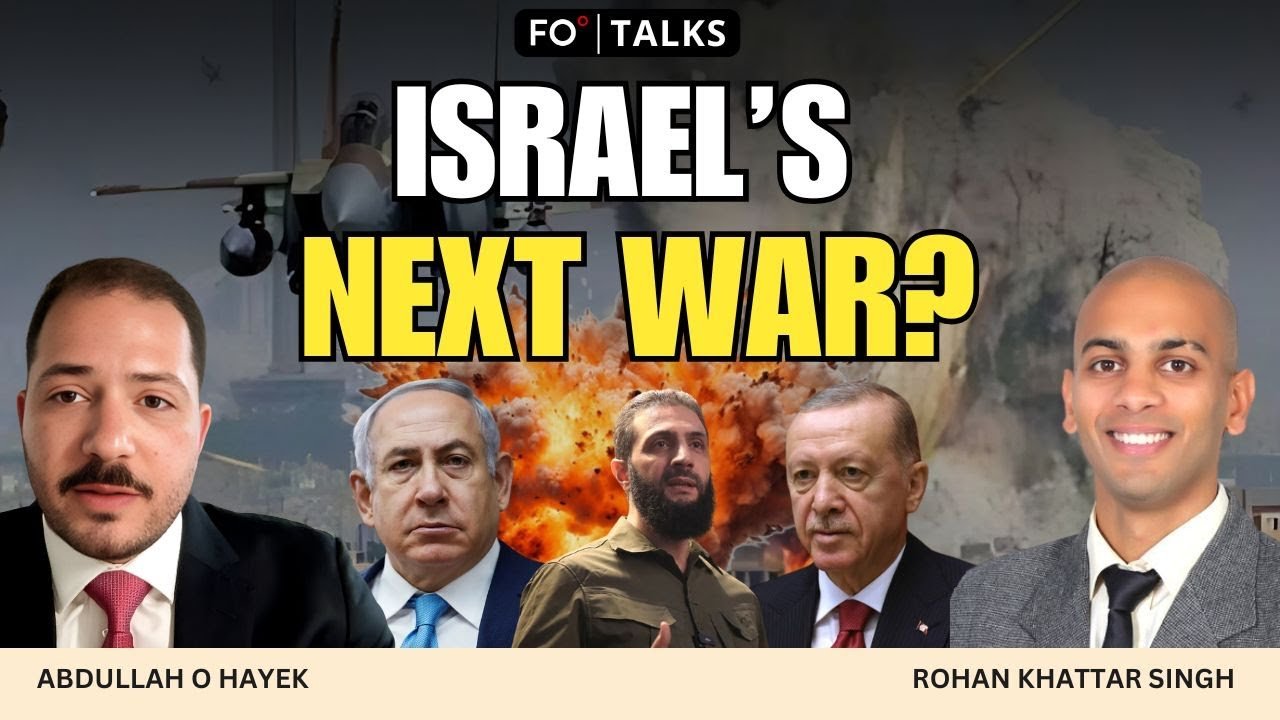
Rohan Khattar Singh, Fair Observer’s Video Producer & Social Media Manager, speaks with independent Middle East analyst Abdullah O Hayek about the sudden derailment of Israel–Syria peace talks and the wider consequences for the region. The conversation traces the fragile optimism of early negotiations, the eruption of sectarian violence in southern Syria and Israel’s overwhelming military response that poisoned the atmosphere of trust. Hayek examines the secrecy surrounding the talks, Israel’s dual strategy of negotiation and consolidation, Turkey’s rising influence and the existential question of whether Syria can hold together as a unified state.
Israel–Syria peace talks
Khattar Singh begins with the extraordinary events of late May and early June, when Israel and Syria quietly entered negotiations. Hayek calls this “nothing short of a geopolitical earthquake” after decades of hostility. Reports suggested a breakthrough was within reach, with Syrian President Ahmed al-Sharaa — formerly Abu Mohammad al-Julani, who toppled Syrian dictator Bashar al-Assad in December 2024 — seeking rapprochement via Emirati and American channels.
US President Donald Trump personally embraced this momentum, meeting Sharaa in Riyadh and lifting sanctions on June 30 as a gesture of goodwill. Israel signaled guarded openness so long as security guarantees and control over the Golan Heights were preserved. Hayek recalls the diplomatic momentum as “unstoppable,” with both sides contemplating normalization by the end of the year.
That optimism collapsed in mid-July. Sectarian clashes between Druze militias and Bedouin tribes erupted in the Suwayda province, near the Golan Heights and Jordan. The violence escalated rapidly, displacing nearly 200,000 civilians and eroding Sharaa’s authority. Accusations that Syrian forces aided atrocities against Druze civilians deepened the crisis, opening the door for Israeli intervention.
Syria–Israel peace deal
Khattar Singh presses Hayek on how close the two sides were to an agreement. Hayek explains that insiders spoke of interim arrangements, even imaginative ideas like a joint “peace park” in the Golan Heights. For Sharaa, peace promised reconstruction, legitimacy and an end to isolation. For Israel, it offered a stable northern frontier and a diplomatic success under the Abraham Accords framework.
Yet sectarian bloodshed and Israel’s massive response destroyed the fragile trust. Hayek insists that both sides share blame, but Israel’s airstrikes — including against Damascus’s Ministry of Defense and the presidential palace — “irreparably poisoned the atmosphere.” From Syria’s perspective, the strikes were a betrayal. From Israel’s, Damascus had failed to control its forces and prevent sectarian killings. The result was the collapse of talks that only weeks earlier seemed within grasp.
Why Israel bombed Syria
The discussion turns to Israel’s intervention. On July 14, Israeli Prime Minister Benjamin Netanyahu declared Israel the “protector of the Druze brethren” and ordered airstrikes against Syrian units. By July 16, Israel had launched more than 160 strikes, extending to central Damascus.
Hayek explains that Israel framed the action as a humanitarian defense and a way to enforce a buffer zone. In reality, it shattered the nascent trust. Russia and Iran echoed Syrian accusations of sovereignty violations, while even Washington urged restraint. Hayek underlines the scale: This was the first direct Israeli assault on Syria’s new government since Assad’s fall. Hayek says that “ultimately, it was Israel that pulled the trigger … it prioritized military force over further dialogue.”
Closed-door talks
Khattar Singh asks why the peace talks were conducted in secrecy. Hayek explains that for Syria, negotiations with Israel were politically explosive. Sharaa faced opposition from Islamist factions, Assad loyalists and Iran-backed militias. For Israel, insisting that its sovereignty over the Golan Heights was “non-negotiable” risked fracturing Netanyahu’s coalition.
Both sides used back channels through the United States and the United Arab Emirates to avoid public backlash and spoilers from Iran or Hezbollah. Netanyahu also avoided openly negotiating with a leader once linked to jihadist groups. Hayek stresses that secrecy was intended to give talks “a chance to succeed,” but in practice, it left them brittle and vulnerable to collapse once violence escalated.
Does Israel want peace?
Khattar Singh asks whether Israel truly desired peace. Hayek argues that Israel had a dual position: It had real incentives for stability and diplomatic progress, but on its own terms. Israel demanded recognition of sovereignty over the Golan Heights and security guarantees above all.
Meanwhile, Israeli forces had already expanded their footprint. Within days of Assad’s ousting, Israel pushed past the United Nations buffer zone, built outposts and declared the 1974 disengagement line void. Combined with the steady expansion of Golan settlements, these moves suggested Israel was consolidating control while talking peace. Hayek calls Israel’s desire “real but extremely conditional,” a strategy of buying time while strengthening its position.
The role of Turkey
Khattar Singh raises Turkey’s role. Hayek explains that Turkey, under Turkish President Recep Tayyip Erdoğan, has been both mediator and disruptor. It supported Syrian rebels against Assad, partnered with Russia and Iran in ceasefire talks, and became a close ally of the Sharaa government after Assad’s fall.
Turkey now provides reconstruction aid, security training and intelligence support, even thwarting assassination attempts against Sharaa. Ankara, the Turkish capital, also brokered a deal forcing the Kurdish-led Syrian Democratic Forces into integration with the new state. Hayek calls this “mediation by leverage:” Turkey knits Syria back together but always in line with its own interests.
Will Syria collapse?
Finally, Khattar Singh asks whether Syria can hold together. Hayek warns of alarming signs: sectarian massacres, militia warlordism and drug trafficking. Minorities such as Alawites and Druze fear for their survival. He foresees the risk of fragmentation into enclaves — Druze, Alawite, Kurdish and Sunni — akin to Yugoslavia or Libya.
Still, Hayek does not believe collapse is inevitable. Sharaa must unify the country through inclusive governance, discipline his military and pursue reconciliation. Disarming militias and integrating fighters through a credible disarmament, demobilization and reintegration program is essential. With policies focused on equality and protection for all communities, Hayek argues, Syria can still avoid disintegration.
A fragile horizon
Khattar Singh and Hayek’s dialogue captures both the promise and peril of the Israel–Syria peace effort. From unprecedented negotiations to devastating violence, the process illustrates how quickly trust can unravel in the Middle East. For Israel, security and territorial control remain paramount. For Syria, survival and unity take precedence. Turkey plays mediator and power broker, while the specter of collapse hangs over the Syrian state.
As Hayek notes, the talks may not have “immediately fizzled out,” but after the events of July, prospects for peace look far-fetched.
[Lee Thompson-Kolar edited this piece.]
The views expressed in this article/video are the author’s own and do not necessarily reflect Fair Observer’s editorial policy.
” post-content-short=” Rohan Khattar Singh, Fair Observer’s Video Producer & Social Media Manager, speaks with independent Middle East analyst Abdullah O Hayek about the sudden derailment of Israel–Syria peace talks and the wider consequences for the region. The conversation traces the fragile optimism of early…” post_summery=”Rohan Khattar Singh and Abdullah O Hayek trace the rise and collapse of Israel–Syria peace talks in mid-2025. Hayek emphasizes that both sides bore responsibility, but Israel’s overwhelming military response destroyed fragile trust and froze negotiations. The discussion widens to Israel’s dual strategy, Turkey’s power plays and the looming risk of Syria’s fragmentation, leaving peace a distant prospect.” post-date=”Sep 21, 2025″ post-title=”FO° Talks: Israel–Syria Peace Talks Derailed After Israeli Airstrikes, Turkey Makes Its Moves” slug-data=”fo-talks-israel-syria-peace-talks-derailed-after-israeli-airstrikes-turkey-makes-its-moves”>FO° Talks: Israel–Syria Peace Talks Derailed After Israeli Airstrikes, Turkey Makes Its Moves

[Though this video is not recent, the authors’ discussion remains relevant today.]
Josef Olmert, an Israeli academic and political commentator, dives into US President Donald Trump’s latest proposals for Gaza and the wider Middle East. Olmert lays out his sharp critiques and his alternative vision. The conversation ranges from the feasibility of mass resettlement of Gazans, to the imperative of destroying Hamas, to the overriding challenge posed by Iran’s nuclear ambitions.
Olmert’s initial confusion
Olmert begins by admitting his confusion. For years, Trump positioned himself as an isolationist, pulling America out of international organizations and pushing to withdraw troops from conflict zones. Yet, in this instance, he called for US military involvement in the border region between Israel and Gaza, an area Olmert describes as “one of the most problematic, dangerous and volatile regions of the world.” To him, the contradiction is striking.
Olmert concedes that Trump possesses a certain originality and “out-of-the-box” vision for solving regional problems. Still, he sees fundamental flaws. Trump assumes a single event or plan can provide a sweeping solution to the Middle East’s problems. Olmert pushes back firmly: “It doesn’t work like that.” Countless grand plans, from peace conferences to international accords, have failed because the Middle East is too diverse, fractured and historically laden with conflict.
Olmert also highlights Trump’s reliance on economic logic. As a businessman, the president tends to see commercial fixes as the path to stability. Olmert acknowledges that raising living standards is desirable, but he stresses that economic growth cannot erase deep-rooted political and ideological struggles. In his words, “The entire foundation, therefore, of the approach is wrong.”
The Gaza population dilemma
Olmert then addresses Trump’s focus on Gaza’s demographic challenge. With over two million people packed into a small territory lacking sufficient infrastructure, the humanitarian strain is undeniable. Olmert agrees that the Gaza Strip “cannot cater for a population of over two million people.” Trump suggested emigration as a remedy, with other countries absorbing Gazans.
While Olmert admits some Gazans might want to leave voluntarily, he dismisses the idea. No country can realistically resettle such numbers, certainly not in a short timeframe. Even if partially successful, the region would destabilize in the transition. He draws on history, recalling how the Oslo Accords quickly unraveled under pressure from opponents. Any drawn-out evacuation, he insists, would invite chaos.
Hamas and security imperatives
Despite his skepticism, Olmert identifies actionable points in Trump’s rhetoric. Chief among them is the call to dismantle the Palestinian Sunni militant group Hamas, which governs Gaza. Olmert stresses his long-held conviction that “if you want to achieve peace along the border between Israel and Gaza, Hamas has to be totally destroyed.” He rejects the notion that peace is possible with actors who categorically oppose coexistence.
He also aligns with Trump on freeing Israeli hostages but asks the crucial question: how? Once again, the removal of two million Gazans is not the answer. Instead, the focus must remain squarely on neutralizing Hamas.
Regional players and fragile balances
Turning to neighboring states, Olmert briefly considers the potential roles of Egypt and Jordan. Egypt, he suggests, might absorb a limited number of people. Jordan, however, already has a fragile demographic balance, with up to 70% of its population being of Palestinian origin. Bringing more Gazans would, in his view, risk destabilizing the Hashemite Kingdom.
While critics of Jordan often highlight corruption or weak institutions, Olmert counters that the monarchy has endured for a century — dismantling it could open doors to even greater instability. “The devil you know sometimes is better than the devils you don’t know,” he says.
Olmert also raises cost concerns. Any plan would require massive financial incentives. Ultimately, he argues, the burden would fall on the US taxpayer.
Saudi Arabia enters the conversation as well. Trump publicly claimed that Saudi Crown Prince Mohammed bin Salman had expressed opposition to a Palestinian state. Olmert considers this disclosure a blunder. Statements that might be tolerated in private, he warns, become problematic when voiced openly, forcing Saudi leaders to deny them.
Iran as the true challenge
For Olmert, the real strategic focus should remain on the Islamic Republic of Iran. He criticizes Trump’s vague comments about sanctions and his willingness to meet the Iranian president. What disturbed him most was the absence of even the boilerplate statement of “all the options on the table.”
He argues that Iran’s nuclear ambitions and regional influence are “the key.” Destroying Iran’s nuclear program, he asserts, would have a far greater stabilizing impact than resettling Gazans. Gulf Arab states, especially Saudi Arabia, live under constant fear of Iran’s expansionist ambitions. Curtailing the nation, he says, would also shift Palestinian attitudes.
Even so, Olmert does not present this as a cure-all. He admits that removing Iran’s nuclear capacity will not solve everything, but it has a higher chance of promoting stability than Trump’s Gaza proposals. Delays in dealing with Tehran, he warns, would allow Iran to accelerate its nuclear program, creating an existential threat for Israel that “Israel should not accept.”
The Israeli domestic reaction
Olmert also examines reactions inside Israel. Right-wing politicians in the ruling Likud party and ultranationalist ministers, such as Israeli Finance Minister Bezalel Smotrich and Israeli National Security Minister Itamar Ben-Gvir, celebrated Trump’s words. Yet they overlooked one critical statement: Trump’s rejection of new settlements in Gaza. This could signal broader reservations about settlement policy, including in the West Bank.
Trump even promised an announcement regarding sovereignty in the West Bank, which Olmert interprets as an attempt to reconcile annexation of certain areas with a two-state framework. In his assessment, the Israeli right wing “doesn’t understand” that Trump operates within international constraints. Aligning too closely with his proposals, Olmert warns, risks global backlash and could isolate Israel.
Re-centering priorities
In closing, Olmert emphasizes what he sees as Israel’s true priority. While Trump shifts focus to Gaza, Olmert insists that “the main thing is still the Iranian problem.” For Israel, he says, the Gaza issue is secondary. Ensuring that the world’s attention remains on Iran — not on Trump’s impractical resettlement ideas — is the strategy Israel must pursue.
[Lee Thompson-Kolar edited this piece.]
The views expressed in this article/video are the author’s own and do not necessarily reflect Fair Observer’s editorial policy.
” post-content-short=” Josef Olmert, an Israeli academic and political commentator, dives into US President Donald Trump’s latest proposals for Gaza and the wider Middle East. Olmert lays out his sharp critiques and his alternative…” post_summery=”In this episode of FO° Talks, Josef Olmert weighs in on US President Donald Trump’s controversial Middle East proposals, focusing on Gaza and beyond. He argues that Trump’s business-minded, simplistic approach cannot address the region’s deep-rooted political and ideological conflicts. The real strategic threat remains Iran’s nuclear ambitions; Israel must not be distracted by Trump’s impractical plans.” post-date=”Sep 20, 2025″ post-title=”FO° Talks: Josef Olmert on Trump’s Gaza Plan” slug-data=”fo-talks-josef-olmert-on-trumps-gaza-plan”>
FO° Talks: Josef Olmert on Trump’s Gaza Plan

[Though this video is not recent, the authors’ discussion remains relevant today.]
Editor-in-Chief Atul Singh and Professor Thomas Barfield discuss whether Taliban-ruled Afghanistan is becoming a “normal state.” While foreign powers engage with the new rulers, Barfield sees little sign of Afghanistan normalizing. Other states do not recognize the Taliban regime, internal fractures are growing, and the growing economic, political and social pressures could destabilize not only Afghanistan, but the wider region.
India, Pakistan and the shifting regional equation
Singh begins by raising India’s recent outreach to the Taliban, a surprising development given India’s bitter memory of the 1999 Kandahar hijacking of Indian Airlines Flight 814. Barfield explains that New Delhi’s calculus is driven less by affection for the Taliban and more by hostility toward Pakistan. Pakistan’s capital of Islamabad, once the Taliban’s key backer, now finds itself bitten by its own creation. India has also invested heavily in Afghan infrastructure and hopes to access Central Asia through Iran’s Chabahar port. Still, Barfield stresses that trust is absent on all sides, calling it a classic “enemy of my enemy is my friend” dynamic.
Recognition without recognition
Barfield points out that no country has formally recognized the Taliban, not even Pakistan. Islamabad withheld recognition after its demands — the acceptance of the Durand Line (the Afghanistan–Pakistan border), suppression of the Tehrik-i-Taliban Pakistan nationalist movement and a halt to cross-border support — saw rejection. The Taliban’s dismissive response, he says, should not have been a surprise. Even during the 1990s, recognition was limited and short-lived.
Today, no government wants to be the first. Yet Barfield notes that pragmatic dealings continue: Qatar and China pursue business, the World Bank runs projects and Uzbekistan sells electricity despite having unpaid bills. Such transactions, he suggests, may buy goodwill and restrain jihadist groups from using Afghan territory.
The economic straitjacket
Despite these engagements, the Taliban remain cut off financially. Their national bank assets are frozen in Switzerland, and lack of recognition blocks access to UN aid and trade agreements. Afghanistan’s economy, Barfield says, is “in a very, very bad way.” Misery may suppress revolt for now, but once suffering normalizes, people begin to ask why they endure it.
This is a dangerous moment for the regime. Barfield warns that revolutions often come suddenly, and the Taliban has reason to fear the speed at which public sentiment could shift.
Four alarming trends
Drawing on a paper he co-authored, Barfield identifies four troubling developments under Taliban rule:
- Their domestic policies endanger Afghan citizens’ security and prosperity.
- Their foreign relations destabilize the neighborhood, especially Pakistan.
- Afghanistan once again risks becoming a base for global terrorism.
- The Taliban relies increasingly on narcotics, particularly heroin and methamphetamine, even while suppressing opium cultivation.
These developments, Barfield argues, underscore that Afghanistan remains more a source of regional risk than a stable state. Iran faces a refugee influx, Pakistan suffers Taliban-backed militancy, and China fears instability spilling into the autonomous region of Xinjiang. The Taliban may not themselves threaten the world, but Afghanistan still shelters groups with global ambitions, including the Islamic State.
Fragile state, fractured society
Turning inward, Singh asks about Taliban governance. Barfield stresses that Afghanistan has never had a dominant military institution like Pakistan. The Taliban’s army functions more as a “super militia,” vulnerable to collapse if legitimacy erodes.
Internally, cracks are widening: Radical restrictions on women alienate even conservative societies, ethnic favoritism toward Pashtuns fuels resentment and Afghanistan’s youthful population faces blocked opportunities. Kabul, a “primate city” with four million people and only 20,000 Taliban, could be the epicenter of an uprising. Ethnic divisions remain premodern, with each group seeking dominance, yet Barfield does not foresee ethnic cleansing or secession. Instead, the central danger is perception: In Afghanistan, no one backs a loser.
Vulnerabilities and the future
Barfield challenges the cliché of Afghanistan as a “graveyard of empires,” calling it instead a “graveyard of analysts looking backwards.” Poorly managed, the United States’ withdrawal erased the fragile republic, leaving the Taliban reliant on external resources yet denied them. He highlights historical lessons from King Mohammad Zāhir Shāh, the last king of Afghanistan, whose compromises sustained stability, in contrast to today’s zero-sum politics.
Looking forward, Barfield sees hazards everywhere: economic collapse, potential Taliban splits, Pakistan’s instability and speculation about a “Khorasan” identity as an alternative to ethnic nationalism. He even warns that the second administration of US President Donald Trump could worsen matters, as Trump’s disdain for foreign spending might cut off vital funds and “hasten [Afghanistan’s] downfall.”
Ultimately, Barfield concludes, Afghanistan will likely hold together, not out of unity but because no ethnic group has a viable nationalist ideology. “Afghanistan is a land of arranged marriages,” he quips, “and nationalism is a romantic enterprise.”
[Lee Thompson-Kolar edited this piece.]
The views expressed in this article/video are the author’s own and do not necessarily reflect Fair Observer’s editorial policy.
” post-content-short=” Editor-in-Chief Atul Singh and Professor Thomas Barfield discuss whether Taliban-ruled Afghanistan is becoming a “normal state.” While foreign powers engage with the new rulers, Barfield sees little sign of…” post_summery=”In this episode of FO° Talks, Atul Singh and Thomas Barfield express that Taliban-ruled Afghanistan is drifting into crisis. No state has formally recognized the Taliban, yet pragmatic dealings continue even as the economy collapses and internal fractures widen. Barfield warns of narcotics dependence, terrorism risks, regional instability and a volatile future for the nation.” post-date=”Sep 19, 2025″ post-title=”FO° Talks: Is the Taliban-Ruled Afghanistan Now Becoming a Normal State?” slug-data=”fo-talks-is-the-taliban-ruled-afghanistan-now-becoming-a-normal-state”>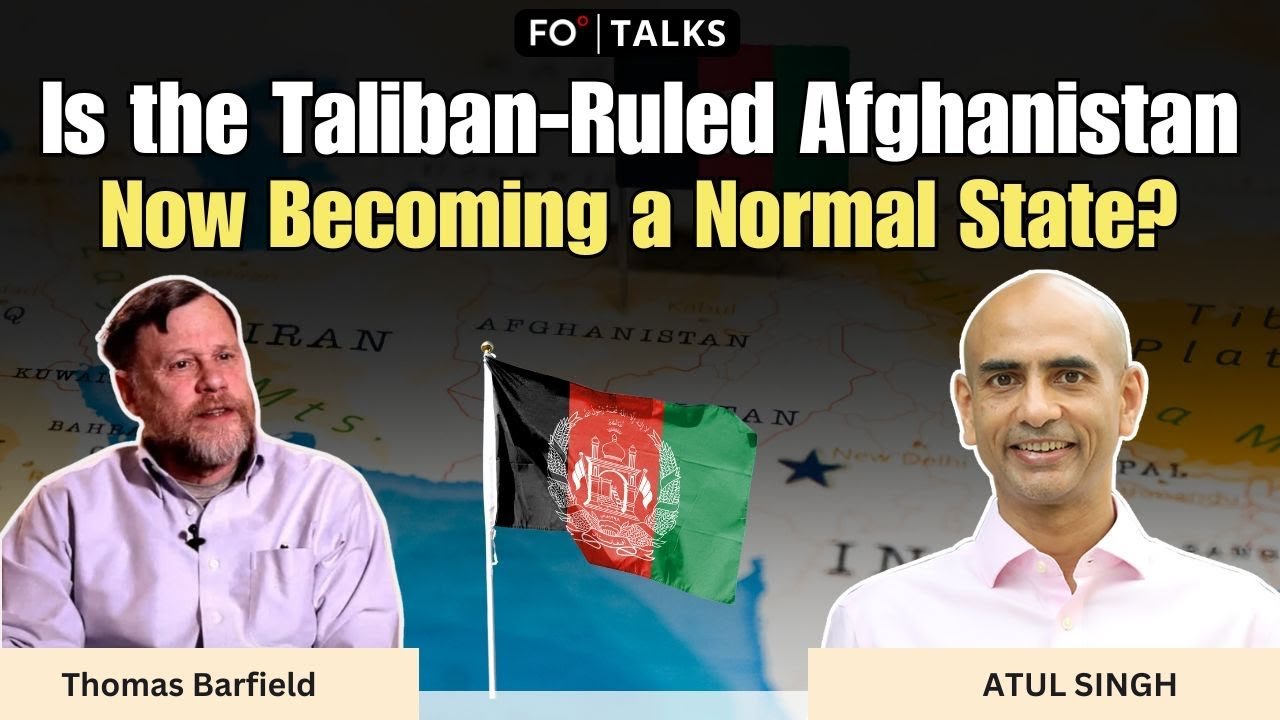
FO° Talks: Is the Taliban-Ruled Afghanistan Now Becoming a Normal State?

[Though this video is not recent, the authors’ discussion remains relevant today.]
Fair Observer Founder, CEO & Editor-in-Chief Atul Singh and Swiss diplomat Jean-Daniel Ruch, a veteran of the Turkish capital of Ankara and the Middle East, explore Syria’s dramatic upheaval and its regional consequences. The conversation highlights the fall of the Assad dynasty, the ascent of new Sunni leadership and the recalibration of regional power involving Turkey, Iran, Saudi Arabia and Israel.
Strategic shifts in the region
Ruch opens by stressing that Syria is undergoing profound strategic changes. He recalls predicting a decade ago that the old Syrian order would collapse, though he did not foresee such rapid change. He lists key developments: the collapse of Iran’s land corridor to the Lebanese Shiite military group Hezbollah, Turkey’s renewed influence, Russian and American hesitation and the re-emergence of energy projects such as a long-discussed Qatari pipeline through Turkey to Europe. These shifts, he argues, will shape not only the Middle East but also West Asia and Europe, especially regarding refugees.
The fall of the Assad regime
Singh summarizes the dramatic recent events: former Syrian President Bashar al-Assad fled to Moscow, ending 54 years of Ba’athist rule. The Alawite minority, dominant since 1970, has lost power, while Sunnis, led by Abu Muhammad al-Julani, the head of the former Islamist military group Hayat Tahrir al-Sham (HTS), seized Damascus in a lightning ten-day offensive. Turkey’s intelligence chief prayed with Julani in the Umayyad Mosque, underscoring Ankara’s backing. Celebrations erupted across Sunni communities, from Pakistan to Bangladesh, marking the symbolic return of the Umayyad Mosque from Shia to Sunni hands.
Historical burdens and Turkish ambitions
Singh asks about Syria’s troubled past. Ruch traces its modern shape to the Sykes–Picot agreement and subsequent French mandate. He notes that outside powers have long dictated order in the region, from the Cold War to the Arab Spring. He emphasizes Turkey’s central role today, with President Recep Tayyip Erdoğan, intelligence head İbrahim Kalın and Foreign Minister Hakan Fidan projecting power rooted in Ottoman legacy. Turkey’s ambitions rest on military strength, economic reach and religious conviction. However, Ruch notes Arab mistrust persists, recalling how Egyptian women during the Arab Spring dismissed Turkish claims of returning.
New balances and fragile alliances
Ruch argues that Julani’s victory is significant but unstable. The challenge lies in power-sharing among Sunnis, Arabs, Kurds, Druze and Alawites, with mediation from Turkey, Saudi Arabia, Egypt and Qatar. He cites the risk of fragmentation: Lebanon may split, Druze may seek Israeli protection, Kurds resist HTS and Alawites retreat to Russian-backed enclaves. Regional powers must negotiate a new balance, while outside actors such as Russia seek to preserve bases in Tartus and Latakia. The 2012 Geneva Communiqué, Ruch believes, still offers a guiding roadmap.
Turkish grooming of HTS and Western involvement
Ruch attributes Julani’s success to Turkish grooming over at least four years, with HTS supplied and trained through Turkey. He estimates HTS commands around 30,000 fighters and speculates that Gulf or even Western funding contributed to the group’s rise. Turkey also relies on the Syrian National Army, effectively an extension of its military, to pressure Kurdish forces.
Ankara’s strategic aim is to establish a 30-kilometer buffer zone free of Kurdish fighters, possibly with US President Donald Trump’s backing. Singh adds reports that Assad’s army collapsed partly because soldiers were unpaid, while Julani benefited from foreign funding. Ruch notes Western efforts to rebrand Julani, once hunted with a $10 million US bounty, into a suit-wearing political leader named Ahmed al-Sharaa, raising doubts over whether this transformation is cosmetic or substantive.
The wider geopolitical picture
The conversation turns to broader dynamics. Ruch highlights Christian minorities’ anxiety, Alawite resentment and the risk of revenge killings. He stresses that justice mechanisms will be essential to avoid cycles of violence. Regionally, he underscores rivalry among Saudi Arabia, Turkey and Egypt for Sunni leadership. Iraq, he suggests, could mediate despite its limitations, recalling its role in the 2023 Iran–Saudi rapprochement. Israel, meanwhile, destroyed Syrian air defenses and sought to prevent a hostile Sunni coalition.
While normalization with Gulf states advanced under the Abraham Accords, Ruch doubts lasting peace without a Palestinian state. He warns that, absent such a resolution, hostility will fester and could erupt in future crises as severe as the infamous October 7 attack on Israelis in 2023.
The broken map
Singh and Ruch agree that Syria, as once defined, will not return. The Humpty Dumpty metaphor looms over their discussion: the old order is shattered and cannot be rebuilt. Whether Julani and his Turkish patrons can forge an inclusive and durable framework remains uncertain. Regional rivalries, sectarian divides and unresolved grievances threaten renewed instability. Yet the stakes are immense: the future of Syria will ripple across West Asia, Europe and the balance of global power.
[Lee Thompson-Kolar edited this piece.]
The views expressed in this article/video are the author’s own and do not necessarily reflect Fair Observer’s editorial policy.
” post-content-short=” Fair Observer Founder, CEO & Editor-in-Chief Atul Singh and Swiss diplomat Jean-Daniel Ruch, a veteran of the Turkish capital of Ankara and the Middle East, explore Syria’s dramatic upheaval and its…” post_summery=”In this episode of FO° Talks, Atul Singh and Jean-Daniel Ruch analyze Syria’s collapse and the shifting balance of Middle Eastern power. They trace the fall of former Syrian President Bashar al-Assad, the rise of HTS leader Abu Muhammad al-Julani, and Turkey’s pivotal role. Syria’s old order is broken, and the region’s future hinges on whether unfriendly powers can coexist.” post-date=”Sep 18, 2025″ post-title=”FO° Talks: Examining Syria Through Swiss Eyes” slug-data=”fo-talks-examining-syria-through-swiss-eyes”>
FO° Talks: Examining Syria Through Swiss Eyes

In this episode of FO° Talks, Fair Observer Contributing Editor Anton Schauble and clinical psychologist and meditation teacher Tucker Peck discuss his approach to Buddhism and his book, Sanity and Sainthood. Peck presents a balanced path between traditional Buddhism and its American offshoots, seeking a grounded, ethics-focused practice rooted in the Pāḷi Canon — the collection of scriptures in the Theravada Buddhist tradition — rather than vague contemporary interpretations. He describes his work as walking a “middle road” — eschewing both rigid metaphysics and watered-down spiritual clichés in favor of an engaged, scripture-informed inquiry.
Studying the oldest texts to teach clearly
Peck began teaching meditation at the age of 29 and quickly realized the importance of anchoring his instruction in canonical texts rather than personal spiritual experiences. He emphasizes the richness and complexity of the Pali Canon, the earliest collection of Buddhist scriptures. Though difficult for newcomers to read due to its length and lack of editing, Peck insists it holds invaluable insights when properly interpreted.
Core Buddhist teachings in a modern context
Peck frames the Buddha as one of history’s intellectual giants. At the heart of the Buddha’s awakening are the Four Noble Truths — particularly the insight that suffering arises from the futile desire to control the uncontrollable. Another essential teaching is dependent origination (Patiṭṭha-samuppāda), which outlines the twelve interlinked processes through which distorted perception fuels stress. Later interpretations, aligned with systems theory, see causality as web-like rather than linear: Everything affects everything else.
Peck also explores the three marks of existence:
- Impermanence (Anicca): Everything is in flux, even if it appears stable.
- Non-self (Anatta): There is no fixed self — everything we identify with, including our own body and consciousness, is merely an object of awareness.
- Dissatisfaction (Dukkha): Clinging to impermanent things for lasting happiness is inherently stressful and misguided.
According to Peck, these three insights reject the metaphysical, psychological and ethical absolutes many traditions depend on. The Buddha, he argues, didn’t aim to create a religion or define a heavenly realm. Early Theravada Buddhism reflects this restraint. However, later Buddhist traditions sometimes ascribe divine qualities to realization, speaking of a “great mind” or “bodhicitta” imbued with wisdom that acts through the practitioner.
Sanity and Sainthood: two goals of practice
Peck’s book title captures what he sees as the twin aims of Buddhist practice:
- Sanity means responding appropriately to reality — not projecting past traumas or imagined fears. Many people, Peck says, are deeply disconnected from their actual experience, leading to unhappiness despite outward success.
- Sainthood reflects the aspiration to be a good person. Here, the enemy is not moral weakness, but the invisible inner forces that drive behavior. Meditation helps reveal these hidden influences — what Peck calls “internal dark money” — so they no longer unconsciously control one’s actions.
The Eightfold Path: a framework for transformation
Peck presents the Eightfold Path as a practical framework, grouped into three categories:
- Intellectual/educational: Right View and Right Aim focus on learning from seasoned practitioners and adopting a worldview that emphasizes cause and effect, and the harm of greed and separation.
- Ethical conduct: Right Speech, Action and Livelihood all revolve around reducing harm and avoiding activities that cloud the mind — from drugs and alcohol to digital distractions.
- Meditation: Right Effort, Mindfulness and Concentration aim to cultivate awareness and insight, especially through the Vipassana meditation technique, which deconstructs perception and experience.
The power and perils of meditation
Peck draws a distinction between casual meditation and intensive retreat practice. A few minutes a day is helpful for everyone, promoting calm and self-awareness. But after 25–40 minutes, meditation shifts into “exposure therapy,” where suppressed thoughts and emotions surface. This can lead to destabilizing experiences, especially for people with recent trauma or unresolved mental health issues.
Some rare but serious side effects include:
- Feeling physical sensations as energy rather than a solid body, disrupting sleep
- Surfacing of psychological content one isn’t prepared for
- Perceptual disturbances from deconstructing sensory systems
Peck warns that intensive practice isn’t for everyone. For some, losing the conventional sense of self can be liberating; for others, it’s disorienting. The key, he says, is the ability to voluntarily return to one’s everyday identity — for example, “Tucker” or “Anton” — when engaging with society.
A personal turn toward Buddhism
Raised Jewish, Peck explored several religious paths before choosing Buddhism. He found Judaism and other traditions either ethically outdated or lacking clear, replicable spiritual practices. Buddhism appealed to him because of its sparse metaphysical demands and its step-by-step guidance for achieving awakening.
Despite textual contradictions, Buddhism struck him as remarkably progressive for ancient India, offering examples of racial and gender equality. He cites a sutta (Buddhist sermon) where the Buddha’s disciple Ananda accepts water from a woman of low caste, rejecting caste hierarchy with the phrase, “I asked you for water, not for caste.” For Peck, viewing all humans as equal is an ethical necessity rooted in the Buddhist principle of non-self.
Why tech workers are drawn to Buddhist practice
Peck notes that a large number of his meditation students are from Silicon Valley. He speculates that people in the tech industry, who often have material security, eventually recognize that their problems are internal. Without external scapegoats for their unhappiness, they turn to spiritual solutions. Buddhism, with its logic-friendly metaphysics and perceived scientific validation, offers a system for mental transformation that appeals to this demographic.
Kalamasutta and the Buddhist epistemic approach
Peck closes by referencing the Kālāma Sutta, which lays out a Buddhist hierarchy of knowledge:
- Lowest: scripture or tradition
- Middle: logical reasoning
- Highest: direct, personal experience
He encourages viewers to experiment with meditation for even five minutes, noting that it can immediately reveal the mind’s patterns. A simple practice he suggests is identifying something one is trying to control that can’t be controlled, and then letting it go, observing the resulting feeling of relief. This kind of empirical, experience-based insight, Peck says, lies at the heart of Buddhist wisdom.
[Tucker Peck’s book, Sanity and Sainthood, is available on Amazon.]
[Lee Thompson-Kolar edited this piece.]
The views expressed in this article/video are the author’s own and do not necessarily reflect Fair Observer’s editorial policy.
” post-content-short=” In this episode of FO° Talks, Fair Observer Contributing Editor Anton Schauble and clinical psychologist and meditation teacher Tucker Peck discuss his approach to Buddhism and his book, Sanity and Sainthood. Peck presents a balanced path between traditional Buddhism and its American offshoots,…” post_summery=”Tucker Peck, a psychologist and meditation teacher, discusses his approach to Buddhism and the goals of “sanity” and “sainthood” in spiritual practice. He explores key concepts like the Four Noble Truths, dependent origination and the three marks of existence. Drawing from ancient texts and his teaching experience, Peck frames Buddhism as a rational, experiential path for understanding and transforming the mind.” post-date=”Sep 17, 2025″ post-title=”FO° Talks: Tucker Peck Tried Every Religion, But Only Buddhism Did THIS to His Mind” slug-data=”fo-talks-tucker-peck-tried-every-religion-but-only-buddhism-did-this-to-his-mind”>
FO° Talks: Tucker Peck Tried Every Religion, But Only Buddhism Did THIS to His Mind

Fair Observer Founder, CEO & Editor-in-Chief Atul Singh talks with Richard Fontaine, the CEO of the Center for a New America, and Robert Blackwill, a former ambassador to India. The guests discuss their book, Lost Decade: The US Pivot to Asia and the Rise of Chinese Power, which examines US foreign policy in Asia after the 2011 “Pivot to Asia” announcement. They argue the 2010s were a critical missed opportunity: While China’s power grew rapidly, Washington failed to follow through on its own strategic shift. By the decade’s end, the United States found itself in a weaker position in Asia than in 2011; it had allowed military, diplomatic and economic imbalances to widen in Beijing’s favor.
The Pivot to Asia: ambition vs. reality
In 2011, Secretary of State Hillary Clinton unveiled a landmark change in US grand strategy — it would be the first time Washington prioritized Asia over Europe. Blackwell and Fontaine agree this was the right call strategically, yet stress it was never carried out in practice.
Multiple forces undercut the Asia Pivot:
- The assumption that US wars in Iraq and Afghanistan were winding down proved false, keeping troops and resources tied up.
- Budget sequestration cut defense spending at precisely the moment Asia required greater investment.
- Russia’s 2014 annexation of Crimea pulled US attention and assets back to Europe.
- Years of diplomatic effort on the Trans-Pacific Partnership (TPP) ended with congressional rejection, followed by US President Donald Trump’s withdrawal.
- Changes in top-level officials and shifting crises made diplomacy inconsistent, blunting the message and the momentum.
Blackwell says the Iraq invasion of 2003 was a strategic mistake on par with Vietnam, noting that the Middle East has repeatedly derailed Asia-focused policy.
The need for the Asia Pivot
Asia’s strategic centrality was already undeniable by 2011. Blackwell outlines its weight: The continent is home to 60% of the global population, 40% of the GDP and two-thirds of global growth. It’s home to half the world’s active-duty personnel and several of its largest defense budgets. Most importantly, it is the base of China, the only country capable of challenging the US as a global leader.
At the time, Washington’s elite consensus still considered the idea that China could be coaxed into becoming a “responsible stakeholder.” Fontaine recalls that US policy in the 2010s leaned heavily toward engagement, with relatively little hedging. It took until halfway through Trump’s first term for the US to formally declare China a strategic competitor.
Current US strategy and limits
Under then-US President Joe Biden, a new Pivot to Asia is underway in concept, yet the authors describe it as overdue and incomplete. The lack of a trade pillar, which has been absent since the TPP’s collapse, remains a glaring weakness.
Fontaine and Blackwill argue the US cannot abandon Europe or the Middle East, but it must make deliberate tradeoffs. Naval and air assets could shift to Asia, with surge deployments available for emergencies like Gaza. In Europe, as allies boost defense budgets, US forces could redeploy eastward. The authors judge a Russian attack on NATO territory as very unlikely, freeing space for reallocation.
Alliances as a strategic anchor
Strong alliances are essential to balancing China’s rise:
- Japan is doubling its defense spending over five years, acquiring strike capabilities and quietly preparing for a Taiwan conflict scenario. Blackwell notes growing Japanese acknowledgment that non-involvement in such a contingency is “almost unthinkable.”
- The Philippines has allowed renewed US access to bases under Filipino President Ferdinand Marcos, reversing a 1991 decision to expel US forces.
- Networking among allies is growing, with Japan–India, Japan–Australia and Japan–Philippines ties deepening. The Quadrilateral Security Dialogue (or the Quad), first conceived by former Japanese Prime Minister Shinzo Abe, shows that partners — not only Washington — are driving regional defense coordination.
Economic gaps
The absence of a major trade strategy undermines US influence. While the Comprehensive and Progressive Agreement for Trans-Pacific Partnership and the Regional Comprehensive Economic Partnership move forward without the US, domestic politics make reentry unlikely. Fontaine and Blackwell stress that smaller-scale digital or sectoral agreements could keep the US economically relevant. Without deeper integration, however, China’s trade influence will continue expanding.
Consultation and credibility
The 2011 Asia Pivot rollout suffered from minimal prior consultation with allies. Many in Asia, Europe and the Middle East were blindsided, leading to fears of abandonment. Blackwell warns that similar missteps now — such as withdrawing from Ukraine — would deeply shake Asian allies’ faith in US commitments. Fontaine underscores that US credibility depends on global consistency, as allies in different regions see their security as interconnected.
China–Russia partnership
Beijing and Moscow now enjoy their closest relationship since before the Sino–Soviet split. This “No Limits” partnership features oil sales, dual-use technology flows and military coordination. They share an ambition to weaken the US-led order, and while they stop short of a mutual defense pact, they cooperate in ways that undermine sanctions and reduce dollar dependence. Fontaine labels their alignment, alongside Iran and North Korea, as an “axis of upheaval.”
US–China relations and Taiwan
Relations are in decline, with Taiwan as the most likely flashpoint. Fontaine sees war as possible but not inevitable, citing strong incentives on both sides to avoid catastrophe. Blackwell stresses that a robust US deterrent reduces the odds of Chinese aggression. Both authors insist that diplomacy must work in tandem with military readiness to manage competition without sliding into open conflict.
[Lee Thompson-Kolar edited this piece.]
The views expressed in this article/video are the author’s own and do not necessarily reflect Fair Observer’s editorial policy.
” post-content-short=” Fair Observer Founder, CEO & Editor-in-Chief Atul Singh talks with Richard Fontaine, the CEO of the Center for a New America, and Robert Blackwill, a former ambassador to India. The guests discuss their book, Lost Decade: The US Pivot to Asia and the Rise of Chinese Power, which examines US…” post_summery=”In this episode of FO° Live, Singh, Fontaine and Blackwill discuss how US policy squandered the 2010s. The guests say it failed to follow through on the Pivot to Asia as China’s power rose. They call for stronger alliances, strategic military shifts, renewed economic engagement and careful diplomacy to protect American interests in the country’s most critical geopolitical theater.” post-date=”Sep 16, 2025″ post-title=”FO° Live: A New Look at Post Asia Pivot US Foreign Policy” slug-data=”fo-live-a-new-look-at-post-asia-pivot-us-foreign-policy”>
FO° Live: A New Look at Post Asia Pivot US Foreign Policy

Fair Observer Founder, CEO & Editor-in-Chief Atul Singh and retired Indian Air Commodore Ashutosh Lal discuss Indian geopolitics. Lal brings more than three decades of helicopter flying experience, including over 8,700 hours, to argue a bold idea: The number and use of civilian helicopters can serve as a revealing index of a nation’s development.
Importance of helicopters
Singh begins by asking why helicopters, rather than jets or airports, should be considered a development metric. Lal explains that helicopters are not just elite toys for wealthy individuals or politicians. Instead, they act as a “great enabler,” connecting remote populations with modern medicine, education and economic opportunities.
In developed nations, whenever a single life is in danger, the state deploys helicopters as a matter of course. This, he says, reflects the true value placed on human life. For Lal, India’s helicopter sector is a test of whether the country is moving toward that standard.
Flying for Indian Air Force
Looking back, Lal recounts India’s early history with helicopters. The first Indian Air Force helicopter unit, the 104 Helicopter Unit, was raised on March 10, 1954. In its early years, the force flew Sikorsky S-55s and Bell 47G craft. India’s diverse terrain, comprising glaciers, jungles, deserts and seas, quickly made helicopters indispensable.
Lal remembers mentors like a pilot nicknamed “Cyclic,” who taught him to appreciate the unique demands of rotary flight. He also describes a deep admiration for naval aviators who land on ships during violent monsoons, a skill honed only through constant exposure. For him, these experiences build a culture of helicopter mastery that India can now bring into the civil domain.
India’s civil helicopter aviation
Singh then turns the conversation to the present state of civil aviation. Lal reports that India has only about 250 to 270 registered civil helicopters. By contrast, a single city like São Paulo, Brazil, has around 750.
Most Indian helicopters are used for offshore oil and gas operations, pilgrimages to inaccessible temples, business charters and political campaigning. Lal imagines a future where a passenger can land at a busy airport and immediately transfer to a helicopter, bypassing traffic altogether. A smaller market exists for pleasure trips, but the glaring gap is in public service operations.
Why India needs more helicopters
Lal underscores that India has almost no Helicopter Emergency Medical Services (HEMS). For a country with one of the highest road accident rates in the world, this absence is a tragedy. Natural disasters such as glacial lake bursts, Himalayan forest fires and train accidents all demand helicopter support, yet the National Disaster Relief Force cannot mobilize them quickly because helicopters do not have “organic availability.” This lack of readiness means lives, property and resources are lost unnecessarily.
Lal notes the irony of India building thousands of kilometers of highways without ensuring helipads for quick evacuation. In his view, “it is not too late,” but urgency is needed.
Helicopters for public service
Positive developments do exist. Singh points out the creation of a helicopter directorate within the Directorate General of Civil Aviation, which Lal praises as an important step. Industry bodies like the Federation of Indian Chambers of Commerce & Industry and the Confederation of Indian Industry are also pushing for reforms.
However, challenges are steep. No Indian airport allows “non-interfering simultaneous operations,” meaning helicopter traffic is delayed by fixed-wing flights. Regulations demand excessive paperwork for foreign pilots. Most significantly, India has no civil helicopter training schools, forcing civilians to study abroad at high cost. About 95% of pilots come from the armed forces, and even then, transitioning them smoothly into civilian roles remains a policy blind spot.
Lal stresses that studies already recommend at least 800 helicopters for India. Meeting this target would create a huge market and expand the nation’s ability to respond to emergencies. For him, helicopters should be treated as essential public-service infrastructure, not occasional luxuries.
Drones or helicopters?
Singh raises the issue of drones as a possible alternative. Lal responds that drones are useful supplements, but they cannot replace helicopters for critical tasks like mass evacuations, medical transport or disaster response. He urges policymakers to adopt a holistic approach that includes drones but builds a strong helicopter ecosystem as the backbone. Without this, India risks throttling its own growth and failing to achieve the vision of “Viksit Bharat” — a truly developed India.
Atul urges the Ministry of Civil Aviation, the Prime Minister’s Office and industry stakeholders in the audience to “get [their] act[s] together and create the architecture.” Helicopters are more than machines in the sky — they are lifelines that reveal whether a nation values every citizen and whether it has the will to act on that principle.
[Lee Thompson-Kolar edited this piece.]
The views expressed in this article/video are the author’s own and do not necessarily reflect Fair Observer’s editorial policy.
” post-content-short=” Fair Observer Founder, CEO & Editor-in-Chief Atul Singh and retired Indian Air Commodore Ashutosh Lal discuss Indian geopolitics. Lal brings more than three decades of helicopter flying experience, including over 8,700 hours, to argue a bold idea: The number and use of civilian helicopters can…” post_summery=”In this episode of FO° Talks, Atul Singh and Ashutosh Lal explore helicopters as a unique development index for India. Lal highlights the Indian Air Force’s legacy, the limited civil fleet and the urgent need for emergency services and disaster response capacity. He calls for systemic reform, infrastructure investment and integration of helicopters as vital public-service tools.” post-date=”Sep 15, 2025″ post-title=”FO° Talks: Here’s How Helicopters Will Make India a Major Geopolitical Power” slug-data=”fo-talks-heres-how-helicopters-will-make-india-a-major-geopolitical-power”>
FO° Talks: Here’s How Helicopters Will Make India a Major Geopolitical Power

Rohan Khattar Singh, Fair Observer’s Video Producer & Social Media Manager, speaks with Bangladeshi journalist Shahidul Alam about Bangladesh’s political upheaval and future trajectory. They discuss the fall of politician Sheikh Hasina, the challenges before Chief Adviser Muhammad Yunus’s interim government, the army’s role, election timing, minority safety, economic repair and shifting external alignments.
Sheikh Hasina’s ouster
Khattar Singh opens by situating Bangladesh within a history that included cycles of military and civilian rule after independence in 1971. He notes the long rivalry between Hasina of the Awami League and Khaleda Zia of the Bangladesh Nationalist Party (BNP). Khattar Singh recounts that in August 2024, student-led protests forced Hasina to resign and flee, which cleared the way for Nobel laureate Yunus to lead an interim government charged with stabilization and fresh elections.
Alam characterizes Hasina’s fall as the product of extraordinary repression. He says United Nations-linked estimates indicated roughly 1,400 people were killed and around 20,000 injured in three weeks, with allegations that forces fired from helicopters and that children were hit by snipers. He argues that Hasina enriched herself, acted with “complete subservience to India” and hollowed out state institutions by co-opting the judiciary, bureaucracy, police and military.
Bangladesh’s army
Turning to the military, Khattar Singh asks how much power it still holds. Alam notes Bangladesh’s long history of generals seizing control, as well as its continued influence even under civilian governments. He recalls “inappropriate comments” made by the army chief but stresses that the real danger lies in the entrenched deep state. This network of officers, once loyal to Hasina, remains intact, and Alam warns that their allegiance is “suspect.” In his view, the survival of Yunus’s interim government depends less on the open stance of the army than on curbing this hidden machinery of power.
The next election
Khattar Singh notes that elections have been postponed multiple times. Alam corrects him and says no date has been postponed because none has been formally set. He explains that an initial window had been discussed for December 2025 to July 2026, that the BNP pushed for December 2025 and that the government later floated April 2026. After Yunus met BNP leader Tarique Rahman, Alam says many now expect February 2026, though no official date has been announced.
Alam adds that people want to vote, since many have not cast a meaningful ballot in 16 to 17 years. He says unity has formed against Hasina’s repression, but he expects divisions to persist as groups press their agendas and as post-uprising expectations collide with governing realities. Euphoria, he cautions, often fades into frustration when results are slower than hoped.
Bangladeshi Hindus
Khattar Singh raises reports of rising violence against Hindus. Alam first clarifies terminology, saying Bangladesh has an interim government, not a caretaker one. He then challenges the premise and says the data does not support a surge of targeted anti-Hindu violence. He cites figures for August 2024 to February 2025 showing 1,254 violent incidents, with only about 20 — roughly 1.6% — classified as communal. Most incidents, he says, were political vendettas that affected Muslims primarily but also Hindus involved in politics or local disputes.
Alam acknowledges that Hindus suffered and must be protected. He adds that minority rights across South Asia remain inadequate. He criticizes India for speaking up only for Hindus while other vulnerable groups in Bangladesh also deserve attention. He notes that these figures were acknowledged by India’s Ministry of External Affairs spokesperson.
Bangladesh’s economy
Khattar Singh turns to jobs and stability. Alam agrees that youth unemployment helped ignite the anti-Hasina movement. He alleges that about $16 billion per year had been siphoned abroad for over a decade, which left the banking system in disarray.
Even so, he points to early improvements: Reserves stopped falling, some foreign direct investment arrived and confidence began to return. He says these are insufficient. Yunus’s microcredit background helps, but Alam argues that broader policy capacity is required. He urges mobilizing the Bangladeshi diaspora’s expertise and, above all, rebuilding confidence. People, he says, have been traumatized, and restoring trust is the essential precondition for investment and growth.
India, Pakistan, China, America
Finally, Khattar Singh asks how foreign policy may evolve. Alam says that ending Hasina’s India-centric tilt creates space for a more independent posture. He says Bangladesh is “developing a spine” and notes warmer ties with the West, aided by Yunus’s personal links to the United States. He also highlights a dramatic improvement with Pakistan, including eased visas and direct bilateral trade, after years in which Pakistan had been treated as a pariah. China, Europe and America, he says, are now engaged through an independent lens rather than an India lens.
Alam emphasizes that India remains too large to ignore. He calls for cordial trade and intellectual collaboration, provided New Delhi stops “playing big brother.” If India acts with generosity, he says, the relationship can flourish.
He closes by warning that misinformation about Bangladesh, especially in India, has strained ties and says that more visitors on the ground would help correct distortions.
[Lee Thompson-Kolar edited this piece.]
The views expressed in this article/video are the author’s own and do not necessarily reflect Fair Observer’s editorial policy.
” post-content-short=” Rohan Khattar Singh, Fair Observer’s Video Producer & Social Media Manager, speaks with Bangladeshi journalist Shahidul Alam about Bangladesh’s political upheaval and future trajectory. They discuss the fall of politician Sheikh Hasina, the challenges before Chief Adviser Muhammad…” post_summery=”In this episode of FO° Talks, Shahidul Alam argues that Sheikh Hasina’s downfall exposed the fragility of Bangladesh’s institutions and dangerous, entrenched power. While Chief Adviser Muhammad Yunus’s interim government raises hopes for elections, stability and reform, Alam warns that public expectations are soaring. The country’s future depends on restoring confidence, protecting minorities and balancing relations beyond India’s shadow.” post-date=”Sep 14, 2025″ post-title=”FO° Talks: Bangladesh: Can Interim Government of Muhammad Yunus Protect Hindus?” slug-data=”fo-talks-bangladesh-can-interim-government-of-muhammad-yunus-protect-hindus”>
FO° Talks: Bangladesh: Can Interim Government of Muhammad Yunus Protect Hindus?

Peter Isackson, Fair Observer’s Chief Strategy Officer, talks with Aidan Grogan, a Liberty University history PhD student and Young Voices contributor. Their discussion, rooted in Grogan’s op-ed, “The Nostalgia for Dark Satanic Mills,” explores American manufacturing, marriage customs, ideological battles and the future of cultural traditions.
Manufacturing in America
Grogan begins by challenging the idea that reviving traditional manufacturing is the key to America’s economic health. He argues that economic history has always moved from agriculture to manufacturing to services, and the United States must embrace this trajectory rather than try to reverse it. While the era of US President Donald Trump emphasized bringing back factories, Grogan stresses that a high-tech service economy, especially with the rise of remote work, offers far greater potential.
He draws a contrast with pre-industrial society, when homes were centers of production. Men worked in the fields while women contributed economically through spinning or weaving while caring for children. Industrialization shifted labor into factories, creating the “dark satanic mills” that Blake described and fracturing family life. Grogan believes remote work can restore the home as an economic nucleus, allowing parents to balance work and child-rearing without the heavy trade-offs of modern arrangements.
Isackson challenges the optimism of this vision, suggesting that current unrest and monopolistic trends in tech may undermine such hopes. Grogan concedes the risks of techno-feudalism but appeals to capitalism’s pattern of creative destruction, arguing that Americans must adapt through education and skills rather than retreat to the past.
Traditional vs modern marriage
The discussion turns to family structures. Grogan explains how the 19th-century reforms consigned women to the home, making them dependent on men’s wages, and how this dependency spurred early feminist movements. In the 20th century, as women entered the workforce en masse, the difficulties of raising children while working outside the home resurfaced.
He sees modern economic shifts as a chance to recover a “complementary” partnership, where men and women contribute differently but equally to family life. Remote work makes it possible to have larger families without sacrificing careers. Isackson, however, questions whether this overlooks deep cultural changes. The liberalization of attitudes toward marriage, sexuality and tradition, he argues, cannot simply be rolled back by an economic shift.
The new elites
Grogan next addresses America’s ruling class. He insists that every society, democratic or aristocratic, has an elite. The problem today is that US elites deny their own role. Instead of providing moral guidance, they embrace what he calls “faux egalitarianism” and “meritocratic hubris.” Professional classes may quietly maintain pre-1960s social norms of marriage and family, but the working class has suffered rising non-marital births and collapsing marriage rates.
He contrasts the old industrial elite, which at least acknowledged public responsibility, with today’s globalized, progressive elite. What is needed, Grogan argues, is a post-populist conservative leadership modeled on figures like William F. Buckley — committed to markets, tradition and family values.
War of ideologies
Isackson frames the cultural conflict as a war of ideologies. Competing nostalgias shape political debates: one for the post-war manufacturing economy and another for traditional family life. Grogan draws a sharp line between them. He says the former is just a longing for a past stage of economic development, whereas the latter is a revival of natural law — universal truths about family and religious practice that reappear across cultures.
This ideological struggle, they agree, is intensified by populist movements. Grogan sees populism, whether from Senior US Senator Bernie Sanders on the left or Trump on the right, as an angry backlash against elites but not a sustainable path. He rejects theories from “post-liberal” that America’s founding was flawed and arguments from “nat-cons” for big-government conservatism. Instead, he calls for rearticulating the best of the conservative tradition for today’s challenges.
Feminism, marriage, customs
The exchange grows sharper around feminism and cultural change. Grogan credits feminism with advancing rights but blames second-wave feminism for encouraging women to prioritize careers over family, which he links to declining marriage rates. He points to the disappearance of shotgun marriage customs and the sexual revolution of the 1960s as critical breaks with Judeo-Christian norms. Isackson pushes back, attributing family breakdown less to ideology than to the consumer society’s logic.
Grogan maintains that natural law ensures a return to family and community as anchors. He cites Israel’s high fertility as proof that tradition and modern prosperity can coexist, though Isackson disputes Israel’s uniqueness as a model. Grogan envisions rebuilding family culture not just through policy but through real communities, churches and extended families — a reinterpretation of former US Secretary of State Hillary Clinton’s “village.”
Isackson closes with skepticism, doubting that Grogan’s vision can prevail given historical momentum, though he admits it is desirable. Grogan accepts that conservatism may be a “long defeat” but insists that the fight must go on. For him, history may move forward relentlessly, but natural law and human adaptability ensure that tradition will eventually resurface.
[Lee Thompson-Kolar edited this piece.]
The views expressed in this article/video are the author’s own and do not necessarily reflect Fair Observer’s editorial policy.
” post-content-short=” Peter Isackson, Fair Observer’s Chief Strategy Officer, talks with Aidan Grogan, a Liberty University history PhD student and Young Voices contributor. Their discussion, rooted in Grogan’s op-ed, “The Nostalgia for Dark Satanic Mills,” explores American manufacturing, marriage customs,…” post_summery=”In this episode of FO° Talks, Peter Isackson and Aidan Grogan debate America’s economic and cultural future, weighing nostalgia for manufacturing against a service economy rooted in remote work and family life. Grogan argues for a new conservative elite to revive tradition and natural law. Isackson remains skeptical, seeing consumerism and historical momentum as stronger forces.” post-date=”Sep 13, 2025″ post-title=”FO° Talks: Traditional or Modern: What Life Do American Families Want?” slug-data=”fo-talks-traditional-or-modern-what-life-do-american-families-want”>
FO° Talks: Traditional or Modern: What Life Do American Families Want?

Fair Observer’s Video Producer & Social Media Manager, Rohan Khattar Singh, talks with award-winning journalist and author Alexis Okeowo about her new book, Blessings and Disasters: A Story of Alabama. She portrays her home state as a land of extremes; it has seen some of America’s worst injustices and greatest triumphs. Okeowo blends memoir, history and reporting to tell what she calls an “alternate history” of Alabama — one that complicates stereotypes, highlights resilience and resonates far beyond the South.
Rewriting Alabama’s story
Okeowo began writing after the 2016 US presidential election, frustrated by narrow portrayals of the South as little more than a caricature of red states and cultural backwardness. Having spent much of her career reporting in Africa and Latin America, she wanted to apply the same nuanced lens to Alabama that she used abroad. She draws on her background as the daughter of Nigerian immigrants who built a life in the South despite intending to return elsewhere. Her parents’ story is emblematic of Alabama’s complexity: They came almost by accident, stayed out of necessity and discovered friendship, work and community.
She situates their experience alongside those of other groups who often fall outside the conventional black-and-white narrative of Alabama. Native Americans, immigrants and Latino families have all made the state their home, even as policy and prejudice sometimes sought to drive them out. Okeowo underscores that their resilience — their refusal to leave, their ability to adapt and their insistence on belonging — is what gives Alabama its true potential.
Okeowo’s book title, Blessings and Disasters, reflects the state’s oscillation between extremes: slavery, Jim Crow discrimination and regressive laws on one side, and the Civil Rights Movement and grassroots organizing on the other. For her, Alabama is both a microcosm of America’s contradictions and a stage for its most pivotal struggles.
Stories and lessons for the world
Like her earlier book, A Moonless, Starless Sky: Ordinary Women and Men Fighting Extremism in Africa, Okeowo’s Alabama narrative focuses on ordinary people in extraordinary situations. She writes about a woman from a multigenerational activist family, the operator of a Confederate museum who preserves a contested history, and a young Latino migrant who unexpectedly became an activist after harsh anti-immigrant legislation was passed. Their stories show how everyday lives can be upended by politics but redefined through courage.
Okeowo emphasizes that Alabama is not unique in its struggle to be understood. Abroad, her Nigerian parents associated the state mainly with the Ku Klux Klan and racism before realizing it contained far more. The same pattern plays out globally: Mexico is often reduced to drug war headlines, Nigeria to corruption and countless other places to their worst crises. What links these regions is the failure of outsiders to look past the most dramatic or negative stories.
By documenting Alabama’s overlooked complexities, Okeowo hopes readers will reflect on their own countries and consider who tells their stories, which narratives get accepted and what is left unsaid.
Persistence amid struggle
A central lesson, Okeowo insists, is the power of persistence. Alabama’s history of progress has been painfully slow, marked by long stretches of stagnation or even regression. Yet despite these obstacles, change has happened because people refused to leave. Communities organized, activists persisted and ordinary families stayed put through generations of hardship. Even now, when new legislation seems to push the state backward, grassroots work continues on the ground.
She argues that this model of persistence — patient, determined and often invisible — carries lessons for societies everywhere. Many today face polarization, authoritarianism or deep structural inequality. Progress is never automatic, she cautions, and sometimes it can take decades to bear fruit. But Alabama shows that incremental, stubborn resistance can eventually reshape even the most hostile environments.
Loving home while acknowledging its sins
The conversation closes with Okeowo’s belief that people can love their homes while still confronting their flaws. Having left Alabama and faced questions about why she would ever stay, she insists that the state’s sins are undeniable and must be critiqued. Yet she is also grateful for the opportunities Alabama gave her family and siblings, and for the sense of belonging it provided.
She frames this as a universal challenge: How can people both acknowledge a place’s history of injustice and still commit to improving it? For Okeowo, this balance is not just possible but necessary. It prevents nostalgia from blinding us to injustice, while also keeping cynicism from erasing the bonds of community. The people who manage to do both — love their homes while striving to change them — are the ones who keep a place alive. That, she concludes, is what ultimately makes Alabama, and indeed any community, worthwhile.
[Lee Thompson-Kolar edited this piece.]
The views expressed in this article/video are the author’s own and do not necessarily reflect Fair Observer’s editorial policy.
” post-content-short=” Fair Observer’s Video Producer & Social Media Manager, Rohan Khattar Singh, talks with award-winning journalist and author Alexis Okeowo about her new book, Blessings and Disasters: A Story of Alabama. She portrays her home state as a land of extremes; it has seen some of America’s worst…” post_summery=”In this episode of FO° Talk, Rohan Khattar Singh and Alexis Okeowo discuss Okeowo’s new book, Blessings and Disasters: A Story of Alabama. She highlights the diversity and resilience of ordinary people improving her home state. Alabama offers a global lesson: Progress is possible through long-term persistence, and one can love a place while acknowledging its sins.” post-date=”Sep 12, 2025″ post-title=”FO° Talks: Alabama Can Teach the World a Lot About Racism, Resilience and Community” slug-data=”fo-talks-alabama-can-teach-the-world-a-lot-about-racism-resilience-and-community”>
FO° Talks: Alabama Can Teach the World a Lot About Racism, Resilience and Community

Fair Observer Founder, CEO & Editor-in-Chief Atul Singh and cultural anthropologist Stephen Huyler discuss Hinduism’s unique features and how it contrasts with Western religions like Christianity, Judaism and Islam. Huyler draws from decades of travel and immersion in India to present Hinduism as an experiential, flexible and diverse spiritual tradition.
An experiential approach to Hinduism
Huyler explains that his understanding of Hinduism comes from living inside Indian homes, shrines and temples. Rather than relying on scriptures or anthropological studies, he believes direct experience is essential. He recounts a transformative moment during a goddess invocation when he felt the divine presence so vividly that it shattered his sense of being an “objective outsider.” For him, “objectivity” is an illusion, and true comprehension must come from sincere participation.
Practical Hinduism, Huyler says, is rooted in the idea that the sacred permeates all life. Unlike Western religions such as Christianity, Judaism and Islam, which often divide the sacred from the secular, Hinduism accepts a wide range of practices, from rituals with bells and mantras to philosophical meditation, as equally valid. He finds it striking that one can be agnostic or even atheistic and still be Hindu. Hinduism, he stresses, is not a single codified religion but “a compilation of hundreds, perhaps thousands of smaller belief systems,” making it endlessly varied and engaging.
Community and the feminine divine
The very word “Hindu,” Huyler notes, originally meant simply “of India,” underscoring Hinduism’s geographical rather than doctrinal origins. In villages, identity is deeply tied to community and nature. Land, water, trees, crops and even houses are infused with sacredness, often personified as local deities. Many of these deities are female, reflecting a worldview where the divine feminine is central.
Huyler emphasizes that Hindu goddesses like Durga and Kali embody Shakti, the raw female energy that can defeat evil where male divinity cannot. In Indian systems, the feminine is often seen as stronger than the masculine, in sharp contrast to Western traditions that portray women as weaker. Singh suggests India may be “the one pagan society that survived the Abrahamic onslaught,” drawing parallels between Hindu goddesses and figures like the Greek goddess, Athena, in ancient Europe. Huyler agrees that this perspective underscores Hinduism’s resilience.
Everyday expressions of the sacred
A key distinction from Western monotheism is the absence of a strict divide between gods and humans. Deities, Huyler explains, are personifications of human archetypes, embodying light, dark and everything in between. The Christian and Islamic conceptions of sin are largely absent; instead of eternal damnation, Hinduism centers on rebirth and karmic cycles. Huyler finds this lack of guilt-based systems particularly appealing. Unlike the exclusivity of Christian sects, Hinduism allows multiple spiritual paths without condemning others as heretical.
For most Hindus, the home is the main place of worship, with women often leading rituals. Huyler describes everyday practices such as household altars to Lakshmi, goddess of wealth, or Ganesha, god of beginnings. Myths like Ganesha’s elephant head, which represents contradiction and interconnectedness, symbolize Hinduism’s acceptance of paradox. The image of Ardhanarishvara — Shiva as half-male and half-female — illustrates balance between masculine and feminine energies, contrasting with the exclusively masculine “God the Father” of Western traditions.
Rituals, symbols and meaning
Huyler points to festivals like Durga Puja and Ganesh Visarjan as examples of Hinduism’s cyclical worldview. Clay idols are worshipped and later immersed in water, symbolizing both reverence and return to nature. This ritual reflects the broader belief in rebirth and interconnection with the earth. At the same time, he acknowledges the paradox of modern India’s pollution, which he attributes to overpopulation and delayed modernization — though this remains his personal view.
He also addresses the often-misunderstood Shiva Lingam, an abstract representation of Shiva. Western scholars frequently interpret it as phallic, but Huyler insists most Hindus do not. He suggests Western views are shaped by puritanical backgrounds that exaggerate sexuality. While Hindu myths include sensuality, he stresses that sexuality is accepted as part of divinity rather than worshipped in itself.
The spirit of Hinduism
Huyler portrays Hinduism as an experiential, pluralistic and deeply interconnected tradition that honors the feminine, accepts contradictions and sees the sacred in every part of life. His personal journey from detached observer to participant shows how Hinduism’s openness can transform not only spiritual understanding but also one’s sense of identity.
[Lee Thompson-Kolar edited this piece.]
The views expressed in this article/video are the author’s own and do not necessarily reflect Fair Observer’s editorial policy.
” post-content-short=” Fair Observer Founder, CEO & Editor-in-Chief Atul Singh and cultural anthropologist Stephen Huyler discuss Hinduism’s unique features and how it contrasts with Western religions like Christianity, Judaism and Islam. Huyler draws from decades of travel and immersion in India to present…” post_summery=”In this episode of FO° Talks, Atul Singh and Stephen Huyler explore Hinduism as an experiential, pluralistic tradition that permeates every aspect of life. Huyler highlights its embrace of the divine feminine, cyclical worldview and rejection of guilt-based systems found in Western faiths. His journey from detached scholar to participant underscores Hinduism’s openness, diversity and transformative power.” post-date=”Sep 11, 2025″ post-title=”FO° Talks: What Makes Hinduism Unique? How Does It Differ from Islam and Christianity?” slug-data=”fo-talks-what-makes-hinduism-unique-how-does-it-differ-from-islam-and-christianity”>
FO° Talks: What Makes Hinduism Unique? How Does It Differ from Islam and Christianity?

Fair Observer Founder, CEO & Editor-in-Chief Atul Singh speaks with cultural anthropologist and historian Steven Huyler about his multi-decade connection with India. Huyler reflects on arriving in India in 1971, the hospitality he received and the ways his experiences transformed his life and work. Together, they explore Western misconceptions, India’s diversity, the contrasts between North and South and the enduring complexities of caste and identity.
India–Pakistan 1971 war
Huyler recalls arriving in India on his 20th birthday, October 27, 1971 — just before the Indo-Pakistani War. He had traveled overland by local transport through nine to 11 countries, including Pakistan, before crossing the tense border into India. He describes soldiers, camouflage, armaments and propaganda signs — “Crush India” on one side, “Crush Pakistan” on the other. This stark moment was his first objective impression of India, framed by war.
India’s hospitality
On entering India, Huyler bicycled a rickshaw himself out of empathy for its elderly driver. His first night was at the Golden Temple in Punjab, where he felt dazzled by the atmosphere and devotion of the community. Soon afterward, in Delhi, he met Kamaladevi Chattopadhyay, Mahatma Gandhi’s associate, a freedom fighter and founder of India’s cottage industries program. Through her, he gained introductions to more than 60 families across India, each instructed to “take care of this boy.”
This opened the doors to Indian homes where he observed daily life and family dynamics. He was particularly moved by the intimacy between grandparents and grandchildren, and by the centrality of the pooja room (a room dedicated to religious rituals and prayer), which he came to see as the cornerstone of family life. Families treated him as an uncle, a gesture of intimacy that warmed his heart and helped him learn to quiet his own presence as a tall American outsider.
Transformed by India
These early encounters became the foundation for his book, Transformed by India: A Life. Huyler describes the work as chronological storytelling, infused with humor, beauty and joy, but also “stark horrors.” He insists that it would be wrong to leave out the difficult aspects of India, because they too shaped his transformation.
Over decades, Huyler has written seven books, curated 25 major museum exhibitions and led tours of India. He sees himself as a “bridge of understanding between the West and India,” or what he calls a “cross-cultural surveyor.” This gives him both breadth — an overview few others share — and limitations, as he remains an outsider without the deep immersion of a specialist.
What the West gets wrong about India
Huyler believes such a bridge is essential because of persistent Western ignorance. For the first 30–35 years of his work, he rarely found India mentioned in history or art history books, except superficially. In his experience, many in the United States reduce India to stereotypes of gurus, Sanskrit and Hinduism. While he acknowledges that Brahmanical Hinduism is part of the picture, he emphasizes that India’s broader culture is built by hardworking people whose contributions are often overlooked.
To ignore India, home to one in five human beings, is in his words a “disservice” to history. He argues that Western civilization has long been interwoven with Indian culture, whether or not it has been recognized. He aims to amplify those overlooked voices.
Why India is different
For Huyler, India’s staggering diversity is its defining quality. He considers it “far more diverse than Europe,” pointing to differences in music, literature, physical traits, food and language. Tamil literature and Carnatic music, he notes, are entirely different from their North Indian counterparts. He highlights how most foreigners think of Punjabi cuisine as “Indian food,” a misconception akin to equating English cooking with French or Italian.
Despite the differences, India has always nurtured interrelationships across its cultures. This constant exchange and adaptation is, in his view, what makes India so unique and endlessly fascinating.
India’s North–South identity
Huyler describes sharp contrasts between North and South India. South India, he says, has historically been less patriarchal, more literate — especially in women’s education — and more protective of women’s creative traditions. The North, by contrast, has endured a more violent history of invasions, partition and trauma, which has left deeper divisions.
At the same time, similarities remain. Across both regions, women are seen as the nucleus of the home, and their creative expression is valued, even if in different forms. Today, Huyler observes cultural cross-pollination everywhere: Southern cuisine like dosas and momos are moving north and northern foods like roti are appearing on southern thalis (meal platters).
Caste and identity
Huyler emphasizes that India’s identity is not disappearing but constantly redefining itself. He acknowledges that urbanization and English education among elites have shifted traditions, but insists that the masses continue to sustain their cultures. He admires how even in Mumbai’s slums, people retain identity and resilience, contrasting this with Western communities where victimhood and a sense of loss often dominate.
He regards caste as deeply complex. It has horrific aspects but also provides continuity and cultural grounding across all Indian religions. Singh points out the injustices of hereditary positions, such as unqualified priests in the city of Varanasi. Both speakers note communities — like Marwaris (an ethno-linguistic group in India’s Marwar region) in business and Tamil Brahmins (an ethnoreligious community in the state of Tamil Nadu) in intellectual life — that have benefited from caste traditions. Huyler admits there is no clear solution to balancing justice with cultural continuity.
Huyler closes with self-reflection: striving to step off his American “high horse,” decode his Western privilege and minimize the distortion of his outsider’s lens. His latest book, Transformed by India: A Life, is available now.
[Lee Thompson-Kolar edited this piece.]
The views expressed in this article/video are the author’s own and do not necessarily reflect Fair Observer’s editorial policy.
” post-content-short=” Fair Observer Founder, CEO & Editor-in-Chief Atul Singh speaks with cultural anthropologist and historian Steven Huyler about his multi-decade connection with India. Huyler reflects on arriving in India in 1971, the hospitality he received and the ways his experiences transformed his life and…” post_summery=”In this episode of FO° Talks, Atul Singh interviews Steven Huyler about his 50-year engagement with India. Huyler recounts his transformative arrival in 1971, the hospitality that shaped his life, and the insights behind his new book, Transformed by India: A Life. Their discussion explores India’s diversity, North–South contrasts, Western misconceptions and the enduring complexities of caste and identity.” post-date=”Sep 10, 2025″ post-title=”FO° Talks: The West Has Ignored India and Been Wrong About It for Years” slug-data=”fo-talks-the-west-has-ignored-india-and-been-wrong-about-it-for-years”>
FO° Talks: The West Has Ignored India and Been Wrong About It for Years
Fair Observer Founder, CEO & Editor-in-Chief Atul Singh and retired CIA Officer Glenn Carle examine US President Donald Trump’s handling of the Ukraine war through two high-profile summits. Trump had campaigned on the promise that he could end the war in 24 hours. But six months into his presidency, Glenn notes, Trump has been “flailing and achieving nothing” on that front, and eventually conceded that “no one knew that the problem was so complex.”
With that backdrop, Trump arranged two dramatic meetings — the Anchorage, Alaska summit with Russian President Vladimir Putin, and the Washington, DC summit with Ukrainian President Volodymyr Zelenskyy alongside European and NATO leaders. The stated objective was peace. The actual outcome, as Glenn bluntly puts it, has been “no peace; there’s been no agreement in view whatsoever, no change whatsoever.”
Glenn’s analysis of the key players
Glenn identifies five central actors in these summits, arguing that each pursued objectives far beyond the narrow question of ending the war.
- Putin: Putin sought to end Russia’s diplomatic isolation, reframe the war’s origins by denying Ukraine’s legitimacy and secure peace on Moscow’s terms — meaning Ukraine would effectively be absorbed. More broadly, he aimed to dismantle the post-1945 international order and replace it with a sphere of influence system in which Russia dominates Central Europe. Glenn emphasizes that Trump has “for decades parroted Russian positions” and shows a “Freudian affinity for strong men and for Vladimir Putin,” giving Putin a real chance of advancing these goals.
- The US under Trump: Although officially the host, the US played a diminished role. Glenn argues the Trump administration “aligned itself … verbatim to the last iota with Russia’s positions.” This weakened NATO and European defense commitments, though European leaders managed to prevent a complete rupture. Trump also made a show of agreeing to sell US weapons to NATO allies, who could then choose whether or not to pass them along to Ukraine — an arrangement Glenn condemns as “totally incoherent” and destabilizing.
- Ukraine: For Zelenskyy, the goals were straightforward: survival as a sovereign state, preservation of critical US support and continued military aid. Zelenskyy could not accept any peace deal that ceded Ukraine’s legal territory.
- EU and NATO Leaders: These leaders, Glenn says, “invited themselves in haste” to block what they feared would be a US giveaway to Russia. Their priorities were to maintain US commitment to NATO and to prevent Trump from imposing a Russia-friendly peace settlement.
- Trump: Trump’s main objective, Glenn states, was “to focus the world’s spotlight on him,” to be “the flame around which all moths turned and flew.” Compared to this, a genuine peace accord was secondary. If that benefited Putin, so much the better. If it guaranteed Ukraine’s independence, “well, okay.”
Consequences and global implications
Glenn concludes that the immediate result of both summits was “essentially zero.” The war continued and no peace framework emerged. Yet the summits came with profound symbolic consequences. By meeting with Putin, Trump partially rehabilitated Russia’s status and further eroded America’s credibility with allies. Glenn sees this as one more step in the breakdown of the normative system of international relations, replaced by “Putin and [Chinese President] Xi Jinping’s sphere of influence system, where power determines who has predominance.”
Atul’s perspective: Europe, leverage and declining cohesion
Atul adds that Putin “had the upper hand” in Alaska, noting that even a photo captured “which cat got the cream.” He stresses that Trump now has “little leverage” over Putin, given his reluctance to aid Ukraine.
Atul then turns to Europe, portraying its leaders as politically weak and unpopular. He cites examples such as UK Prime Minister Keir Starmer, UK Member of Parliament Nigel Farage and French President Emmanuel Macron, accusing them of “genuflecting so aptly in front of Donald Trump,” a man they neither like nor admire.
Atul underscores that this posture reflects weakness. In his view, European leaders are fragmented, unpopular at home and unwilling to bear the heavy costs of war. Europe increasingly resembles “an aging continent” without the resilience to confront crises.
Ukraine’s bleak future
The war’s trajectory looks grim. Ukraine faces manpower shortages so severe that the military is desperately conscripting men in their sixties. This, Atul warns, points toward “grimmer” consequences ahead. He links Ukraine’s struggle abroad with democratic decline at home in the US. The presence of the National Guard in Washington, DC, signals what he calls the internal “collapse of rule of law.” If the US cannot uphold norms at home, he suggests, it cannot sustain them abroad.
Atul ends with a historical analogy. Today’s world order, he argues, resembles the unstable periods before both world wars. “The old order is dead,” he says, “and we don’t know what new order is to be born.”
[Lee Thompson-Kolar edited this piece.]
The views expressed in this article/video are the author’s own and do not necessarily reflect Fair Observer’s editorial policy.
” post-content-short=” Fair Observer Founder, CEO & Editor-in-Chief Atul Singh and retired CIA Officer Glenn Carle examine US President Donald Trump’s handling of the Ukraine war through two high-profile summits. Trump had campaigned on the promise that he could end the war in 24 hours. But six months into his…” post_summery=”In this section of the August 2025 episode of FO° Exclusive, Atul Singh and Glenn Carle discuss US President Donald Trump’s fruitless Alaska and Washington summits on the Ukraine war. Glenn says most participants pursued broader strategic goals, while Trump was motivated chiefly by ego and Russian alignment. Europe is politically weak and Ukraine’s position is worsening.” post-date=”Sep 07, 2025″ post-title=”FO° Exclusive: The Story of Alaska and Washington DC Summits” slug-data=”fo-exclusive-the-story-of-alaska-and-washington-dc-summits”>
FO° Exclusive: The Story of Alaska and Washington DC Summits

Fair Observer Founder, CEO & Editor-in-Chief Atul Singh and retired CIA Officer Glenn Carle emphasize that the United States is entering dangerous new territory under the administration of US President Donald Trump. They find the erosion of the independence and credibility of core institutions charged with safeguarding economic stability most alarming. In particular, the Treasury Department appears to be extending its influence into areas traditionally reserved for other agencies, attempting to control both fiscal and monetary policy.
That kind of concentration of power is usually found in developing nations that suffer from poor economic organization. These economies, whether their failures stemmed from oppression, exploitation or sheer mismanagement, often saw high inflation. One example Atul gives is Turkey; Turkish President Recep Tayyip Erdoğan “wanted lower interest rates and the central bank went along — and, of course, the end result was high inflation.”
Traditionally, Washington has drawn a firm line between fiscal policy — taxation, spending and debt, all managed by the government — and monetary policy, which is the preserve of the Federal Reserve, or the Fed. This separation ensures that politicians cannot tinker with interest rates to win short-term electoral advantages, avoiding the destabilizing stop-go economic cycles that plagued economies like Britain’s. Most functioning economies today separate fiscal and monetary policy. The current administration chipping away at that firewall in the US is, in Atul’s words, a “bloody bad idea.”
Assault on the BLS
The first and perhaps most visible breach comes with Trump’s firing of Bureau of Labor Statistics (BLS) Commissioner Erika McEntarfer after the release of what he called “phony” job numbers.
The move shocks markets, especially the $2.1 trillion Treasury Inflation-Protected Securities (TIPS) market. TIPS are designed to shield investors from inflation, but they rely on accurate data from the BLS. If those figures become politically manipulated, investors lose their hedge, and the entire instrument collapses in credibility. As Atul puts it, “this is bad for US bonds, this is bad for [the] US, period.”
McEntarfer had been appointed by the prior administration and was widely considered a respected economist rather than a partisan appointee. His removal signals, in the speaker’s words, that the US isn’t “any different than China” when it comes to official data credibility.
Trump’s replacement, EJ Antoni III, is the chief economist at the Heritage Foundation. This is the same think tank that authored Project 2025, the ideological blueprint behind Trump’s second term. The appointment raises fears inside the federal bureaucracy. Employees quietly admit to “panicking,” worried that their good-faith reporting of data could cost them their jobs if results are deemed politically inconvenient.
Trump justifies his move by branding the BLS’s July report, which showed only 73,000 new jobs and included downward revisions of 258,000 jobs for May and June combined, as rigged. Yet, as Atul and Glenn explain, revisions are normal: Job reports are built from survey samples, with initial numbers incomplete and later updated as more information comes in. This is standard practice, not bias.
The greater concern is what happens next. Statisticians may now feel pressure to massage data into headline figures acceptable to the Trump administration, even if underlying numbers tell another story. Already discrepancies have appeared: The BLS reported a 2.2% increase in food costs at home, while prices for staples like milk (+4.5%), eggs (+16.9%), chicken (+4.5%) and bananas (+7.2%) rose much higher. These numbers lead Gary Grappo, a Fair Observer board member and economist, to say, “Maybe there is something fishy going on.”
Upheaval at the IRS
The Internal Revenue Service (IRS) is another institution the Trump administration is throwing into turmoil. Trump removed Commissioner Billy Long, later dispatching him to Iceland as ambassador, and installed Treasury Secretary Scott Bessent in his place. This makes Bessent the seventh head of the IRS in 2025 and the sixth under Trump — an unprecedented rate of turnover that strongly suggests instability.
At the same time, the IRS faces sweeping budget cuts tied to former Special Government Employee Elon Musk’s Department of Government Efficiency. These cuts create “complete upheaval and pandemonium,” undermining the agency’s ability to collect taxes effectively.
Atul connects this dismantling to the broader Project 2025 agenda: shrinking government not just rhetorically but operationally. Republicans frequently argue that lower taxes mean smaller government and greater freedom, but critics note the blind spot — such cuts balloon deficits. Estimates suggest that slashing IRS staff and halting modernization will cost the government at least $80 billion annually in uncollected revenue. That, paradoxically, worsens the fiscal position the administration claims to be fixing.
Strike on the Fed
The most consequential front may be the Fed. This organization has long been considered the crown jewel of American economic governance, tasked with promoting maximum employment and stable prices. Its structure — with seven governors serving staggered 14-year terms — was designed to insulate it from political whims and guarantee both stability and renewal. Atul reminds viewers that vacancies occur every two years, a feature meant to keep the board refreshed while preserving continuity.
Since 1971, when the US dollar was severed from gold, Fed independence has been treated as an “article of faith” in US politics. Former Fed Chair Paul Volcker’s fight against runaway inflation in the 1980s cemented its credibility, underpinning the dollar’s role as the global reserve currency.
Trump, however, openly challenges this foundation. At a White House bill signing in June 2025, he announced plans to force the Fed to lower rates, insulting Chairman Jerome Powell — whom he appointed in 2018 — in the process. Trump said: “If we cut our interest by one point, for years we save $300 billion. If we cut it by two points, we save $600 billion a year … all because of one numbskull that sits here.” Bessent echoes the pressure, signaling the administration’s willingness to steamroll the Fed.
Fed Governor Lisa Cook became the first target, fired under a cloud of allegations about falsified loan documents. The Department of Justice even pressed Powell to dismiss her outright, escalating political pressure into a direct institutional challenge. Whether those charges justify her dismissal is legally murky; normally, presidents must show clear cause to remove a Fed governor.
Don Moynihan, a professor of public policy at the University of Michigan, describes the case as “lawfare,” noting that mortgage irregularities of this sort are common among lawmakers with multiple homes — but Trump is using them to purge opponents. Markets interpret Trump’s move as an alarming precedent, raising fears of further purges. Cook’s firing remains an ongoing case.
The motivations are transparent. With federal debt expected to top $37 trillion and the One Big Beautiful Bill Act alone projected to add $4.1 trillion by 2034, Trump and Bessent see rate cuts and dollar devaluation as ways to “inflate away” the burden. They also hope lower rates will boost lackluster job numbers. Bessent himself has claimed that “any model” supports rates 150–175 basis points lower, implying a fed funds rate of just 2.6% versus the current 4.33% — even though Producer Price Index inflation is running at 3.3%.
Economists across the spectrum reject his claim as absurd. Inside the Fed, officials warn that all central banks are “in the credibility business.” They see Bessent’s rhetoric as directly undermining that foundation.
Critics deride Trump and Bessent’s aim as reckless. Artificially cheap money, they argue, risks reigniting the stop-go economy of the 1970s, where bursts of growth gave way to painful recessions. Worse, meddling erodes the intangible but vital “animal spirits” that economist John Maynard Keynes described — business confidence, investor trust and the belief that rules matter.
Fed economists quietly fear a return to stagflation, the toxic mix of weak growth and high inflation that defined the 1970s. For them, the administration’s actions are not just policy shifts but existential threats to the credibility that makes the US financial system the backbone of the global economy.
The bigger picture
What unites the BLS firings, IRS chaos and Fed interventions is a single theme: the undermining of institutional independence. The US, once admired for its robust separation of powers and credible technocratic agencies, is being reshaped into something more personalized, less rule-bound and far riskier.
Atul and Glenn warn that this shift effectively replaces a “government of laws” with a “government of a man.” By stripping agencies of autonomy and credibility, Trump is concentrating authority in ways more typical of fragile or authoritarian systems.
This move brings stark potential consequences. Investors may lose faith in the accuracy of economic data. Markets may question whether the US will honor its debt commitments. Ordinary Americans may discover that statistics no longer reflect their lived reality, eroding trust in government altogether.
US economic governance is dramatically deteriorating. With every move Trump makes to politicize independent institutions, the risk of a full-blown crisis grows.
[Lee Thompson-Kolar edited this piece.]
The views expressed in this article/video are the author’s own and do not necessarily reflect Fair Observer’s editorial policy.
” post-content-short=” Fair Observer Founder, CEO & Editor-in-Chief Atul Singh and retired CIA Officer Glenn Carle emphasize that the United States is entering dangerous new territory under the administration of US President Donald Trump. They find the erosion of the independence and credibility of core institutions…” post_summery=”In this section of the August 2025 episode of FO° Exclusive, Atul Singh and Glenn Carle discuss the Trump administration’s actions to erode the independence of core US economic institutions, from the Bureau of Labor Statistics to the IRS and Federal Reserve. Firings, partisan appointments and budget cuts undermine stability. These shifts heighten the risk of an economic crisis.” post-date=”Sep 06, 2025″ post-title=”FO° Exclusive: Dramatically Deteriorating US Economic Governance” slug-data=”fo-exclusive-dramatically-deteriorating-us-economic-governance”>
FO° Exclusive: Dramatically Deteriorating US Economic Governance
Fair Observer Founder, CEO & Editor-in-Chief Atul Singh and retired CIA Officer Glenn Carle discuss US President Donald Trump’s moves against the federal government. While media commentary and partisan opposition often frame Trump’s actions in simplistic terms, the deeper ideological roots and radical ambitions of his administration remain poorly understood.
For Glenn, this is not a matter of routine political conflict. He describes it as “hugely significant,” even “appalling and terrifying,” because it represents a deliberate revolution in the structure of the American state — one with consequences that reach far beyond the United States.
The ideological roots
Glenn traces this movement back decades, noting that figures like political activist Grover Norquist laid the groundwork. Norquist, who graduated from the University of Texas in 1975, was once Glenn’s classmate. Peers dismissed him and viewed him as a gadfly — “a good-natured irritant and not someone to be taken particularly seriously.”
For over 50 years, Norquist convened Washington’s influential Wednesday Morning Group. Here, Republican strategists refined a vision of government so small he could, in his famous words, “drag it into the bathroom and then drown it in the bathtub.”
At the time, Glenn dismissed this rhetoric as absurd. With hindsight, however, he acknowledges that Norquist’s ideological project was both coherent and relentless, making him “one of the significant figures in the last 50 years.” What once sounded like hyperbole has now become the intellectual backbone of a movement reshaping the federal government itself.
The Trump administration’s embrace
According to Glenn, Trump personally has little interest in ideology. Yet his administration — particularly the intellectuals around him — has embraced this agenda with fervor. “The thinking people in his administration do [care],” Glenn remarks.
Atul recalls conversations with younger staffers from Heritage Foundation backgrounds who approach governance with a “crusading zeal.” They are convinced that regulation suffocates competitiveness, that bureaucrats are “leeches who live off taxes” and that only a government stripped to its bare essentials can unleash true freedom. Their reverence for US President Ronald Reagan, who famously declared that government was the problem rather than the solution, borders on worship.
Glenn places this in the larger context of American conservative thought, pointing to institutions like the American Enterprise Institute and the Heritage Foundation. These groups helped cement the idea that “small government is good, and government is the ill.” Glenn satirically likens this belief system to “adolescents who have suffered arrested development and remain obsessed by Ayn Rand and The Fountainhead.”
For many in this circle, this Russian-American writer and philosopher is the philosophical goddess: Government is by definition oppressive, the strong must be free to compete and take care of themselves, and those who cannot survive on their own should, in Glenn’s words, “fail and die.” Atul adds that Rand herself, despite her libertarian philosophy, ran her intellectual circle as an authoritarian cult. She even made her husband wear bells on his shoes so she and her younger lover would hear him coming.
The goal that emerges from this tradition, Glenn explains, is stark: shrink the federal government by half. Its only legitimate purposes should be national defense and border security. Glenn asks if this philosophy “rings and bells?” The approach is to aim high and achieve at least part.
A radical transformation in practice
In its first seven months, Trump’s second administration has begun to put this vision into practice. The pace and scope, Glenn argues, amount to nothing less than a “broad attack” on the structure of government.
It has made sweeping personnel cuts. About 150,000 federal employees, roughly 6% of the workforce, have already been dismissed. Within the intelligence community, the CIA has discussed eliminating a quarter of its staff. Entire agencies have been gutted: The US Agency for International Development is effectively dead, the State Department has suffered steep reductions and the Office of the Director of National Intelligence is in decline.
Other vital institutions are in turmoil. The Federal Emergency Management Agency, which responds to natural and manmade disasters, is “being decimated.” The National Institutes of Health and the Centers for Disease Control face similar gutting. NASA’s budget has been slashed by half, and federally funded research and development in universities is collapsing.
Glenn points out that starving research & development serves a double purpose: It reduces spending and simultaneously cripples the “woke liberal elite intellectuals” in universities, whom the administration views as enemies.
The administration’s 2026 budget proposal is even more radical, targeting an overall 22.6% reduction in the federal government. For Glenn, this marks an ideological project dressed in fiscal language — a deliberate reengineering of the American state.
Unitary executive theory
Behind these actions lies a constitutional philosophy: the unitary executive theory. Glenn calls attention to its origins in the work of Carl Schmitt, the Nazi legal theorist who argued that sovereignty must be concentrated entirely in the executive. In this model, “anything that challenges the authority and the agency of the chief executive must be eliminated or destroyed.” Glenn bluntly calls this structure “a dictatorship.”
This doctrine is central to Project 2025, the blueprint for Trump’s second term. Its prescription is explicit: “The entire executive branch must be brought under direct presidential control.” This represents a profound break from the American tradition of government by laws, in which agencies operate with independence grounded in congressional legislation. The unitary executive theory would eliminate that independence, subordinating all power to the White House.
Under such a system, the federal government is reduced to two aforementioned core functions: national defense and border security. Defense spending has already increased by 9%, while immigration enforcement has escalated. Hundreds of thousands of migrants have been detained and expelled already; this is only the beginning, as the administration has previously mentioned deporting 13 million people. That’s roughly 4%–5% of the national population.
Warnings from history
Glenn cannot overstate the stakes of this transformation. He warns that “80 million people were killed as a result of movements of this sort 80 years ago in a hideous war.” During the first administration of US President George W. Bush and the so-called Global War on Terror, he saw the unitary theory gaining traction. It was used to justify enhanced interrogation techniques. Vice President Dick Cheney’s office ran meetings — even on Chinese policy — where one assistant directly told CIA Officer Glenn, “But YOU are the enemy.”
Glenn sees Trump’s ideological revolution, grounded in a philosophy of executive supremacy and disdain for government institutions, as part of a lineage of authoritarian experiments with devastating consequences.
The danger is clear: The world’s most powerful democracy is sliding into a system that Merriam-Webster itself would define as fascism — a centralized autocratic regime headed by a dictatorial leader, with severe regimentation and forcible suppression of opposition.
[Lee Thompson-Kolar edited this piece.]
The views expressed in this article/video are the author’s own and do not necessarily reflect Fair Observer’s editorial policy.
” post-content-short=” Fair Observer Founder, CEO & Editor-in-Chief Atul Singh and retired CIA Officer Glenn Carle discuss US President Donald Trump’s moves against the federal government. While media commentary and partisan opposition often frame Trump’s actions in simplistic terms, the deeper ideological roots…” post_summery=”In this section of the August 2025 episode of FO° Exclusive, Atul Singh and Glenn Carle argue that US President Donald Trump’s second administration is attacking the federal government, rooted in decades of conservative ideology. Personnel cuts, gutted agencies and sweeping budget reductions aim to shrink Washington’s power and centralize authority. This authoritarian trajectory echoes dangerous historical precedents.” post-date=”Sep 05, 2025″ post-title=”FO° Exclusive: Donald Trump’s Assault on the Federal Government” slug-data=”fo-exclusive-donald-trumps-assault-on-the-federal-government”>
FO° Exclusive: Donald Trump’s Assault on the Federal Government
Fair Observer Founder, CEO & Editor-in-Chief Atul Singh and retired CIA Officer Glenn Carle open the August 2025 edition of FO° Exclusive with a quick look back at the whirlwind of July. The United States finalized trade agreements with the EU and Japan, a “tectonic diplomatic shift” unfolded on Palestine and the so-called “MAGA [(Make America Great Again)] rebellion” flared over the Jeffrey Epstein files controversy. Those developments set the stage for a tense and turbulent August, where fresh crises broke out across multiple regions.
The war in Gaza and Israeli divisions
The ongoing war in Gaza dominated August’s headlines. Anger over the conflict grew not only worldwide but also inside Israel. Roughly 600 former Israeli security officials — including ex-chiefs of Israel’s Mossad intelligence and Shin Bet security agency, as well as senior Israel Defense Forces generals — sent a letter to US President Donald Trump urging him to pressure Israeli Prime Minister Benjamin Netanyahu to end the fight. They argued Israel had already achieved its military goals against the Hamas terror group and that hostage negotiations could not progress until the war stopped. Further, they could not agree to any deal to release the remaining hostages while the conflict still raged.
Yet Netanyahu’s government stood firm, with hard-right figures retaining sway. Former Israeli government official Josef Olmert’s phrase “right-wing nutters” was used to describe their continued grip on policy.
Greenland: Denmark confronts Washington
Another diplomatic headache emerged in the Arctic. Denmark summoned America’s top diplomat over covert US operations in Greenland. These efforts were reportedly led by US intelligence officials, who, in Atul’s words, took “a page out of [Russian President] Vladimir Putin’s book” to move Greenlanders toward closer integration with the US. Copenhagen, Denmark’s capital, viewed the influence operations as a serious breach and summoned the ambassador to lodge a formal protest.
Armenia, Azerbaijan and Trump’s quest for a legacy
Amid the turmoil, Trump appeared to score a diplomatic win. Reportedly, he brokered a peace deal between Azerbaijan and Armenia, a long-running flashpoint after wars in Nagorno-Karabakh and disputes over Nakhchivan, the capital of the Nakhchivan Autonomous Republic — an enclave of Azerbaijan. Azerbaijan had already expelled ethnic Armenians from Karabakh, but the new agreement was cast as an opening for stability.
Europe’s immigration battles
Migration once again inflamed European politics. In Italy, right-wing Prime Minister Giorgia Meloni — labeled “far right, even fascist” by some critics — reacted furiously to a European Court of Justice ruling that struck down her government’s policy of outsourcing migrant processing to Albania.
Meanwhile, Britain and France formalized an arrangement to return illegal migrants crossing the English Channel in small boats. United Kingdom Prime Minister Keir Starmer claimed this “one-in, one-out” system would “send a clear message” to illegal channel-crossing immigrants. Yet Rory Stewart, co-host of The Rest is Politics podcast, argued only wholesale deportations would halt crossings. Nigel Farage, leader of the Reform UK party, pushed even further, proposing a repeal of human rights laws to permit mass expulsions of asylum seekers. He claimed such steps were “absolutely essential” to prevent “major civil disorder.”
Japan’s defense pivot
Japan also made headlines with a $6.5 billion contract to supply advanced frigates to Australia. The ships are highly automated, with crews of only 90 workers — half the crew size of existing Australian vessels. For Tokyo, this was the biggest defense export since it lifted its post-war arms ban in 2014. The move underscored Japan’s push to remilitarize and become a “normal nation,” a shift certain to unsettle Beijing and other regional powers.
Africa and Latin America: overlooked upheavals
In Africa, violence raged in Sudan and the Democratic Republic of Congo with no sign of ending. In Latin America, Bolivia lurched to the right. The Movement Toward Socialism party, dominant for two decades, collapsed to just 3% support. Centrist Rodrigo Paz Pereira led the first round of voting and will face right-wing former President Jorge “Tuto” Quiroga in the runoff.
Elon Musk, Trump and market interference
Tesla CEO Elon Musk’s fortunes were also in the spotlight: The auto manufacturer awarded him shares worth about $24 billion, boosting his stake to 15%, after he threatened to quit. His SpaceX Starship, the world’s most powerful rocket, completed its tenth test flight — it reached outer space and returned to Earth successfully.
Meanwhile, Trump has reportedly considered converting the CHIPS and Science Act into equity, taking a 10% stake in the Intel semiconductor manufacturer. He initially demanded that Intel CEO Lip-Bu Tan step down, but later backed down. He also mocked Goldman Sachs chief David Solomon, criticizing the bank’s tariff forecasts and suggesting Solomon “focus on being a DJ.”
Atul underscores Trump’s paradoxical stance: a self-styled champion of free markets resorting to aggressive state interference.
Tariffs and trade turmoil
On the trade front, Washington and Beijing extended their tariff truce another 90 days, with November 10 set as the next deadline. Conversely, on August 27, Trump blindsided India by slapping 50% tariffs on most Indian exports. FOI, of which Atul is a partner and Glenn a senior partner, had predicted this as early as April 2024, contrary to Indian officials and business leaders who insisted tariffs were impossible given Indian Prime Minister Narendra Modi’s friendship with Trump. “I guess we were right, they were wrong,” Atul gloats.
The three big stories of August 2025
Atul continues by identifying this episode’s three most pressing issues:
- Donald Trump’s Assault on the Federal Government.
- Dramatically Deteriorating US Economic Governance.
- The Story of Alaska and Washington, DC Summits.
[Lee Thompson-Kolar edited this piece.]
The views expressed in this article/video are the author’s own and do not necessarily reflect Fair Observer’s editorial policy.
” post-content-short=” Fair Observer Founder, CEO & Editor-in-Chief Atul Singh and retired CIA Officer Glenn Carle open the August 2025 edition of FO° Exclusive with a quick look back at the whirlwind of July. The United States finalized trade agreements with the EU and Japan, a “tectonic diplomatic shift”…” post_summery=”In this section of the August 2025 episode of FO° Exclusive, Atul Singh runs through crises stretching from Gaza to Greenland. In August, Europe experienced battles over immigration, Japan signed a historic defense deal, US President Donald Trump intervened heavy-handedly in business, and imposed high tariffs on India.” post-date=”Sep 04, 2025″ post-title=”FO° Exclusive: Global Lightning Round up of August 2025″ slug-data=”fo-exclusive-global-lightning-round-up-of-august-2025″>
FO° Exclusive: Global Lightning Round up of August 2025
Rohan Khattar Singh, Fair Observer’s Video Producer & Social Media Manager, talks with DC Agrawal, an activist and urban transport consultant. Agrawal was one of the earliest Indian Americans to protest Indian Prime Minister Indira Gandhi’s Emergency in 1975. Agrawal played a key role in founding Indians for Democracy (IFD), a movement of expatriates dedicated to restoring democratic rights in India. Over the years, he has also been involved in developmental organizations and contributed to the establishment of the New Jersey Transport Corporation.
In this conversation, Agrawal reflects on his activism during the Emergency, the challenges of mobilizing the Indian diaspora in America and the global significance of their efforts.
Indira Gandhi’s Emergency
Agrawal recalls June 25, 1975, as a watershed moment in Indian politics. On that day, Gandhi’s administration arrested opposition leaders, including Jayaprakash Narayan, and the prime minister declared an internal Emergency. She suspended civil liberties and imprisoned thousands. For Agrawal, who was already engaged in developmental causes, this moment underscored the fragility of democracy.
He places these events in context: America at the time was witnessing anti-Vietnam War protests, while Indians had only recently supported Gandhi during the Bangladesh Liberation War. India itself was still reeling from droughts and famine in the late 1960s, experiences Agrawal witnessed firsthand.
Protests in America
On June 30, 1975, just days after the Emergency was declared, Agrawal and his friends, including Anand Kumar — a close associate of Narayan — organized a protest outside the Indian Embassy in Washington, DC. Agrawal drove from Philadelphia to Maryland to join the organizers.
In the days leading up to the demonstration, they circulated petitions, collecting names and states of residence. Many were hesitant to provide full details. Those who did were, in Agrawal’s words, “fairly brave souls,” given the “fear complex” in the community.

At the embassy, officials refused to accept the petitions. The protesters left them on the steps, where Agrawal, a photographer, captured a striking image: the petitions scattered on the ground beneath the boots of a heavy police presence summoned by the embassy. To him, the image symbolized how power structures resist dissent. It even reminded him of fascist imagery from Italian dictator Benito Mussolini’s regime in World War II.

How Indian Americans united
The following day, the Washington Post published photos of the protest in its newspapers. Soon after, the protesters held a press conference at the National Press Club, calling for the Emergency to be lifted, political prisoners freed and democratic rights restored.

They continued with demonstrations on August 15 — India’s Independence Day — in front of the ambassador’s residence in Washington, at the Indian consulate in New York, and in Chicago. IFD also began publishing a newsletter: Indian Opinion.

Agrawal emphasizes that the group stayed “Gandhian in spirit,” deliberately non-partisan and focused on democracy rather than party politics. Their supporters came from across the spectrum — from Rashtriya Swayamsevak Sangh (RSS) right-wingers and Jan Sangh to leftists — and tried to maintain neutrality.
Global media coverage
Without today’s communication tools, mobilization depended on cold-calling Indian names in phone books and organizing at Indian stores. They received mixed responses: Some hung up, some feared reprisals but donated money, while others quietly supported.
The Indian embassy, meanwhile, monitored activists, photographing them and even revoking passports. Kumar, a PhD student at the University of Chicago, had his government scholarship suspended, which drew headlines. Support also came from India Abroad, a new newspaper committed to covering censorship in India; Indian papers blacked out entire articles.
Initially, American media, including The New York Times, were sympathetic to Gandhi. They interpreted events through a Cold War lens. But credibility shifted when she postponed elections in 1976. Support from groups like the Quakers and the American Friends Service Committee, who were “friends of [Jawaharlal] Nehru and [Mahatma] Gandhi,” also boosted the movement. Major outlets like The Wall Street Journal, The New York Times and The Washington Post began covering the protests more seriously. Congressmen arranged hearings in Washington with testimony from Indian leaders such as Subramanian Swamy and Ram Jethmalani, supported by Senator Ted Kennedy’s office.
Walk for Human Rights
By the fall of 1976, the activists sought a bold, symbolic action. They launched the Walk for Human Rights from Independence Hall in Philadelphia to the United Nations in New York, ending deliberately on October 2 — Mahatma Gandhi’s birthday.

The Gandhian, non-violent march lasted ten days. It began with 30–40 people and consolidated into a committed group of about ten. The walkers stopped at several universities, including Temple University in Pennsylvania, Princeton University and Rutgers University in New Jersey, and Columbia University in New York. Here, they spoke about human and political rights.
Agrawal says the march increased their credibility both with the diaspora and with Indian officials. He later learned that Indian minister YB Chavan asked US President Gerald Ford to ban the demonstrations. Ford reportedly refused, affirming that America was a democracy.
For participants, the walk was cathartic. Agrawal believes it even pressured Gandhi, who cared deeply about her global image, to reconsider her position. He argues this contributed to the Emergency being lifted and elections being called in 1977.
The diaspora during Emergency
The Indian diaspora in America at the time was tiny — perhaps fewer than 100,000, concentrated in universities and a few cities. Most professionals avoided involvement, fearing repercussions for themselves or relatives in India. Students were more active, though some leftist groups criticized IFD’s Gandhian methods as “too docile.” Meanwhile, supporters of RSS and Jan Sangh pursued their own lobbying and fundraising, especially as many of their families were directly affected by arrests.
Agrawal reflects that even today, in moments of crisis, only a small minority of Indian Americans would get directly involved, while most would remain passive or offer private support.
Aftermath and legacy
The Emergency ended on March 21, 1977. The Indian government held elections later that year. Agrawal and his colleagues sent a detailed letter to the new prime minister, Morarji Desai, and Members of Parliament, urging reforms such as repealing the Maintenance of Internal Security Act and creating a Right to Information Act.
In October 1977, Agrawal became one of four activists invited to meet Desai and External Affairs Minister Atal Bihari Vajpayee. Both leaders thanked them for their efforts. Agrawal remembers the meeting as gratifying, even if not all their proposals were adopted. For him, the experience confirmed the value of diaspora activism in defending India’s democratic traditions.

[Lee Thompson-Kolar edited this piece.]
The views expressed in this article/video are the author’s own and do not necessarily reflect Fair Observer’s editorial policy.
” post-content-short=” Rohan Khattar Singh, Fair Observer’s Video Producer & Social Media Manager, talks with DC Agrawal, an activist and urban transport consultant. Agrawal was one of the earliest Indian Americans to protest Indian Prime Minister Indira Gandhi’s Emergency in 1975. Agrawal played a key role in…” post_summery=”In this episode of FO° Talks, DC Agrawal discusses the efforts he and other Indian Americans took in 1975 to petition Indian Prime Minister Indira Gandhi’s Emergency. He recalls organizing early embassy protests, building Indians for Democracy and launching the Walk for Human Rights to draw global attention. He further reflects on how international pressure helped restore Indian democracy.” post-date=”Sep 03, 2025″ post-title=”FO° Talks: How Indians in US Fought Against Indira Gandhi’s Emergency” slug-data=”fo-talks-how-indians-in-us-fought-against-indira-gandhis-emergency”>
FO° Talks: How Indians in US Fought Against Indira Gandhi’s Emergency

Rohan Khattar Singh, Fair Observer’s Video Producer & Social Media Manager, talks with Daniel Bunn, President and CEO of the Tax Foundation, about the rise of digital services taxes (DSTs). They explore what these taxes are, why governments are introducing them, their impact on consumers and businesses, and how the United States — particularly under US President Donald Trump — has responded. At the heart of the debate lies a simple but pressing question: Who really pays the price when governments tax digital platforms?
What is the digital services tax?
DSTs emerged in Europe after a European Union-wide DST proposal in 2018 failed. Several member states then implemented their own versions, and the trend has since spread worldwide. Unlike corporate taxes, which target profits, DSTs are levied on revenues — usually from large tech firms such as Google, Amazon, Netflix and Uber.
Bunn stresses that this makes DSTs regressive. Companies with smaller margins face heavier burdens than those with higher ones. From the American perspective, taxing revenues rather than profits is discriminatory because it disproportionately affects American tech giants.
Governments can determine which companies must pay the tax, but they cannot control how businesses react. Firms may raise prices, cut wages or reduce shareholder payouts to offset the cost — outcomes that lawmakers often underestimate.
Netflix, Prime to be costlier?
Services like Netflix, Amazon Prime, Uber and YouTube Premium fall directly under DST regimes. Bunn explains that many providers simply pass the tax along, either to advertisers, small businesses that depend on their platforms, or end users themselves. For everyday consumers, that can mean higher subscription prices. For small businesses, it could mean steeper advertising or product placement fees.
The effect cascades down the supply chain, making it less clear whether DSTs truly tax big corporations or instead squeeze consumers and small players. In Bunn’s view, this indirect burden should force policymakers to reconsider whether DSTs are the right tool, compared to more transparent approaches like value-added tax (VAT).
Big Tech being targeted?
DSTs raise the question: “Is it a start of a global tax revolution, or is this just another sneaky way of taxing the Big Tech?” Bunn leans toward the latter. He argues that politicians are essentially eyeing successful American companies and demanding a cut. Critics call the taxes messy and inconsistent, as they don’t fit neatly into profit-based or consumption-based categories.
Bunn suggests that countries should instead adapt their existing VAT or Goods and Services Tax systems to include digital consumption. Many jurisdictions already do this successfully, providing clearer rules and avoiding the distortions DSTs create.
Trump vs digital taxes
Several countries, including India and Canada, have pulled back from DSTs in part because of US pressure. India dropped its plan in line with the Organisation for Economic Co-operation and Development framework, while Canada retreated after trade threats from Washington.
Bunn characterizes Trump’s approach as aggressive and sometimes even harmful, but acknowledges that it achieved limited success. Targeting Canada worked, but EU member states are harder to pressure since taxation is set at the national level, while trade policy rests with Brussels, Belgium.
Trump’s trade war
During Trump’s first term, his administration prepared “tailored tariffs” to match the revenue countries expected from DSTs. These tariffs were designed as retaliation against jurisdictions that taxed US digital companies. According to Bunn, the groundwork for such measures is already in place, and they could be revived quickly if DST tensions flare again.
This is a bipartisan issue: Democrats and Republicans alike have voiced concern about discriminatory digital taxes. That consensus means future US governments are likely to keep a hard line.
Who really pays?
Ultimately, the costs of DSTs rarely stop with Big Tech. While some companies may absorb the expense, many shift it onto consumers, advertisers and small businesses. In some cases, companies might even scale back services in jurisdictions with DSTs, leaving users with fewer choices.
The bigger problem, Bunn warns, is the lack of consistent definitions and frameworks. A single digital transaction could, in theory, be taxed multiple times by different jurisdictions, creating a “messy” global landscape. For millions of Internet users, the debate over DSTs is not abstract policy — it directly shapes the price, quality and availability of the services they rely on every day.
[Lee Thompson-Kolar edited this piece.]
The views expressed in this article/video are the author’s own and do not necessarily reflect Fair Observer’s editorial policy.
” post-content-short=” Rohan Khattar Singh, Fair Observer’s Video Producer & Social Media Manager, talks with Daniel Bunn, President and CEO of the Tax Foundation, about the rise of digital services taxes (DSTs). They explore what these taxes are, why governments are introducing them, their impact on consumers and…” post_summery=”In this episode of FO° Exclusive, Rohan Khattar Singh and Daniel Bunn discuss digital services taxes (DSTs). Bunn outlines how these revenue-based taxes, aimed largely at US tech giants, often shift costs onto consumers, advertisers and small businesses. The discussion highlights US President Donald Trump’s aggressive trade retaliation strategies, global pushback and the uncertain future of DSTs.” post-date=”Sep 02, 2025″ post-title=”FO° Talks: Your Netflix, Prime, Hulu, Hotstar Could Get Costlier, Here’s Why” slug-data=”fo-talks-your-netflix-prime-hulu-hotstar-could-get-costlier-heres-why”>
FO° Talks: Your Netflix, Prime, Hulu, Hotstar Could Get Costlier, Here’s Why

[This video was recorded in the days preceding the first round of Bolivia’s election. It has been updated to include more recent information.]
Rohan Khattar Singh, Fair Observer’s Video Producer & Social Media Manager, talks with Leonardo Vivas, professor of political economy at Leslie University in Massachusetts, about Bolivia’s presidential election. It had its first round of votes on August 17 and will have a run-off vote on October 19. This conversation examines why these elections matter, the collapse of the long-dominant Movement Toward Socialism (Movimiento al Socialismo, or MAS), the weakened roles of former Bolivian President Evo Morales and incumbent Bolivian President Luis Arce, and more.
Why Bolivia matters
Vivas begins by noting that Bolivia, a small landlocked country, might seem peripheral to global politics, but its elections reflect important regional dynamics. In Latin America, most conflicts in recent decades have been resolved through democratic institutions rather than violence, with the exceptions of Cuba, Venezuela, Nicaragua and increasingly El Salvador. He argues Bolivia is likely to continue this democratic pattern: There will be a clear winner, and institutions will accept the outcome.
The second reason for global attention is the apparent “demise” of MAS, the party founded by Morales in the 1990s and dominant for nearly 30 years. Vivas believes its decline could reshape local geopolitics, breaking one of the region’s longest political hegemonies.
The race and the MAS collapse
The field of candidates reflects MAS’s diminished standing. Morales’s former protégé, Arce, opted not to run again due to poor approval ratings. Two MAS candidates competed — Senate president Andronico Rodriguez and Arce’s former interior minister — but both polled poorly and will not continue to the second round of the vote.
The opposition appears stronger. Samuel Doria Medina, a wealthy businessman, campaigned as a moderate, aiming to unify the country. His rival, former Bolivian President Jorge “Tuto” Quiroga, takes a harder right stance, promising IMF-backed reforms and economic stabilization. Vivas frames the contest as a struggle between a fading MAS and a reenergized right.
In the first round of the vote, Senator Rodrigo Paz Pereira, a centrist from the Christian Democratic Party, and Quiroga, a conservative, came in first and second place, respectively.
Morales, Arce and the end of an era
For much of the 2000s, Morales oversaw what could be called a “Bolivian miracle.” Gas exports funded poverty reduction and indigenous inclusion, with then-Finance Minister Arce shaping the economic boom. Yet the model collapsed as state-owned gas firms faltered, revenues plunged and exchange-rate pressures deepened.
Today, Arce faces a financial crisis marked by exchange controls and slowing growth. With his political support underwater, he chose not to seek reelection. Morales, once a towering figure, is now legally and politically sidelined. A constitutional court ruling bars him from running; his recent protest calls fell flat and he faces prosecution for statutory rape, further eroding his influence.
Morales has refused to endorse MAS’s current candidates and has instead called for new elections, further fragmenting the movement he once embodied.
The army on the sidelines
Military involvement in Bolivian politics has long been a concern, especially after Morales’s 2019 departure under army pressure. But Vivas stresses that today’s army plays little role. A supposed coup attempt last year proved hollow; General Juan José Zúñiga acted alone and was quickly rejected by both society and the president. Some even suspect the episode was staged to boost Arce’s legitimacy.
Compared to 2019, when the military simply facilitated a constitutional transfer of power, today’s officers remain firmly in the barracks. Vivas does not foresee the army influencing this year’s election.
Economy and the younger vote
The central issue now is the economy. During Morales’s rise, indigenous identity and social inclusion drove politics. After decades of reform, indigenous participation is normalized. Economic hardship — falling gas revenues, high inflation and slow growth — has replaced identity as the defining theme.
The generational shift is also decisive. Younger Bolivians, more urban and educated, care less about old ideological battles and more about future prospects. Many no longer rally behind Morales or MAS, instead leaning toward opposition candidates. Vivas highlights that MAS, as the architect of the current crisis, cannot credibly present itself as the solution.
Indigenous voting patterns reflect this shift: Morales still retains support in the highlands, but lowland communities lean right, accelerating MAS’s decline.
Round two is inevitable
Vivas correctly assumes that the election will head to a runoff. He believes it is possible, though not guaranteed, that both right-wing candidates advance to the second round. Much depends on whether MAS’s residual support materializes late in the race.
Based on pre-election information, Vivas sees the likely outcome as a right-wing victory. This would normalize Bolivian politics, making it resemble Argentina, Brazil, Chile and Ecuador, where power alternates between left and right. For him, that normalization marks Bolivia’s reintegration into regional democratic trends.
External players: US, China and Brazil
Vivas also considers the international angle. The United States has lost much of its regional influence, supplanted by China’s growing role. Washington’s attention has shifted to global crises, leaving Latin America low on the agenda. Vivas sees US President Donald Trump’s current administration as “playing wait and see” while expecting right-wing gains across the region.
China’s involvement is more cautious. Burned by its unpaid investments in Venezuela, Beijing is wary of Bolivia’s struggling state-owned companies and is unlikely to engage deeply if MAS wins. Still, China maintains strong trade links, regardless of ideology.
Brazil, under President Luiz Inácio Lula da Silva, could prove more active. As interim head of BRICS, Lula has suggested BRICS could replace the IMF as a source of financing for Bolivia. But such programs remain untested, and Vivas doubts they would materialize unless Bolivia’s government aligns with BRICS priorities.
Cautious optimism
Despite crises, Vivas ends on a hopeful note. He believes Bolivia has a real chance, no matter who wins, to reset its politics and rebuild its economy. For him, the 2025 election could mark both the end of an era dominated by MAS and the beginning of a more balanced, democratic cycle with wider implications for Latin America.
[Lee Thompson-Kolar edited this piece.]
The views expressed in this article/video are the author’s own and do not necessarily reflect Fair Observer’s editorial policy.
” post-content-short=” Rohan Khattar Singh, Fair Observer’s Video Producer & Social Media Manager, talks with Leonardo Vivas, professor of political economy at Leslie…” post_summery=”In this episode of FO° Talks, Leonardo Vivas explains why Bolivia’s 2025 election matters, highlighting the collapse of former Bolivian President Evo Morales’s MAS party and deepening economic troubles. He correctly predicts a second round, unlikely to be interrupted by military action. He remains cautiously optimistic that this election could start a more balanced, democratic cycle for the country.” post-date=”Sep 01, 2025″ post-title=”FO° Talks: Bolivia: Fuel and Economic Crisis Lead to Widespread Support for the Right” slug-data=”fo-talks-bolivia-fuel-and-economic-crisis-lead-to-widespread-support-for-the-right”>
FO° Talks: Bolivia: Fuel and Economic Crisis Lead to Widespread Support for the Right

Russell Stamets, a partner at FOI and a US lawyer with over 25 years of experience helping companies conduct business in India, presents three key mistakes companies make when entering the Indian market, with advice on how to avoid them. He observes that business interest in India is at an all-time high, with global shifts prompting companies to reduce dependence on China and view India as a priority market. Despite this potential, India poses unique challenges, and even the smartest companies can falter.
Stamets candidly stresses that India is “not an easy market.” Its infrastructure, legal system and politics demand preparation. In his decades advising clients, he has seen both major multinationals and nimble startups stumble. The most common errors, he explains, are deceptively simple but consistently mishandled.
Mistake one: mishandling cultural differences
Cultural understanding in India is essential. Stamets clarifies that etiquette like handshakes or business cards is not the issue; what matters is “how you present yourself to India and show you understand and appreciate its culture.”
He warns that superficial gestures backfire. Former Canadian Prime Minister Justin Trudeau and Amazon CEO Jeff Bezos, for instance, donned elaborate Indian dress only to be dismissed as performative. He advises that companies should instead “be authentic, be respectful and be adaptive.” Hiring local talent can help, but the practice is no silver bullet. He points to the Hyundai Motor Group and LG Electronics corporation as examples of foreign firms that succeed while staying true to their identity.
Mistake two: offering products that do not fit Indian needs
Too many companies fail to localize offerings. Stamets cites the Ford Motor Company, General Motors, the Walt Disney Company and Harley-Davidson, which all struggled by ignoring price points or consumer habits. He mentions the Kellogg’s cereal company as a failure-to-success example; it initially “flopped because most Indians prefer hot milk with cereal,” but it adjusted its formula and branding. Harley-Davidson, he adds, is now reentering through a joint venture with Hero MotoCorp, offering smaller, more affordable bikes.
The lesson: “Understand the Indian consumer as she exists in reality, price appropriately, offer features that suit actual habits and preferences.”
Mistake three: underestimating political and regulatory complexity
India’s layered federal system creates shifting rules from state to state, even city to city. Stamets advises companies to identify early which level of government matters most and to plan for both compliance and enforcement.
If there is any “good news,” he remarks, it is that burdens fall equally on foreign and Indian firms. The Information Technology company Infosys Limited, for example, grew in Bangalore partly to avoid politics in New Delhi. He also recalls Bira 91, an Indian beer brand that soared after 2015 but saw its initial public offering delayed two years by trademark and regulatory snags. So, regulatory risk in India is constant and requires resilience and vigilance.
A final warning
Stamets offers a bonus tip: “Don’t fall for the India story.” He acknowledges India’s vast potential but warns that rosy headlines often conceal real obstacles. His advice: Ground strategy in fact, test assumptions and plan carefully. India rewards those who respect its complexity and adapt quickly.
[Lee Thompson-Kolar edited this piece.]
The views expressed in this article/video are the author’s own and do not necessarily reflect Fair Observer’s editorial policy.
” post-content-short=” Russell Stamets, a partner at FOI and a US lawyer with over 25 years of experience helping companies conduct business in India, presents three key mistakes companies make when entering the Indian market, with advice on how to avoid them. He observes that business interest in India is at an…” post_summery=”In this episode of FO° Talks, FOI Partner Russell Stamets outlines three major mistakes companies make when entering India: mishandling cultural differences, failing to localize products and underestimating regulatory complexity. Superficial gestures and generic strategies often backfire. Corporations should remain authentic, adapt quickly and ground business plans in reality.” post-date=”Aug 31, 2025″ post-title=”FO° Talks: Here’s What American Companies NEED to Know Before Investing in India” slug-data=”fo-talks-heres-what-american-companies-need-to-know-before-investing-in-india”>